Saturday, August 30, 2008

The Fat That Makes You Stronger


So I caught the first act of Breakfast, Lunch & Dinner by Luis Alfaro at the Oregon Shakespeare Festival tonight. A fun/ny play about Minerva, a woman who is growing increasingly and uncontrollably obese and the people around her who have to deal with her -- sports-minded himself a couch potato husband, her younger very sexually active sister, and her sister's new cop boyfriend. And, oh yeah, Mee Chee, an even fatter Chinese lady whom she befriended at the fat farm. Minerva sporadically writes letters to Mee Chee inviting her to come visit, and sends little treats (ho-ho's, licorice, funions) along as well. Well, Mee Chee does show up at the end of Act One, but she is not played by an actor, as far as I could tell. She was a large shadow that appeared against a scrim, accompanied by some chinky music. When someone asks her a question, Mee Chee answers as an erhu melody. It kind of gives that Charlie Brown effect, you know when the adults talk, it's this indecipherable "hwa-hwa-hwa" sound? I wasn't entirely sure what that was supposed to signify exactly, but somehow, the appearance of the Mee Chee doppelganger is a transitional moment for Minerva, as she actually begins to FLOAT over everybody and transcends her physical reality.

Still being on East Coast time, I couldn't bring myself to stay awake through the second hour of the show, so I may never find out what spiritual epiphanies awaited Minerva, and whether her obesity was a metaphor for something else.

I am feeling a great trepidation about theater right now, I must admit.
The whole convention of it -- the perfectly timed music to cover scene changes, the theatrical writing and character development... I feel so disconnected to it when I'm watching. May be time for something else... but what?

Wednesday, August 20, 2008

a jump in the pool

OK OK OK! So my show is finished, I went to Japan and back, and I have very little excuse for not having gone to see more shows, except that I'm entirely burnt out and don't want to go to the theater at all. That's why I went to see Headlong Dance Theater's Hotel Pool, because it takes place, well, in and around a pool. In this case, the body of water was located near the southern tip of Manhattan in a high-end luxury condo building called Rector Square.

The show was sold-out a while back, but Banana who has some roots in Philly, had made reservations early on. We arrived quite early on a rainy Thursday, and were one of the first people in the lobby, waiting. By the time they tarted opening the house and shuffling people into the pool area, we were at the end of the line. By the time we reached the performance space, we were one of the last ones in, and had to settle for a seat on the ground, right alongside the pool. There were rolled up towels placed along the poolside, suggesting what was to come.

The piece began with what I found to be an arresting, Murakami-esque premise. A business woman checks into a hotel, but somehow gets lost on her way to her room and ends up at the hotel pool, and locking herself in(out). She makes some frantic phone calls, in an attempt to get the hotel management to get her an actual room. She needs to take her medication and pops a pill into her mouth, when she realizes that her water bottle is empty. Looking around, the only water is... in the pool. Gingerly she kneels down and takes the water up to her mouth in cupped hands. She falls asleep at the poolside. Then a troupe of mysterious water-beings begin an underwater dance that continues throughout the piece, eventually tempting the woman into their universe.

What these water-creatures are, and what they represent, is never entirely clear -- they seem to be emblematic of the spirit of love/fun/life/joy, in contrast to the woman who is coming from a cold, corporate place. Although other stretches seemed lengthy, and there was a whole scene with dialogue in the middle which I couldn't comprehend at all (sound too low, dvd player not working). Plus I got my butt SOAKING WET (like peed-in-my-pants wet --- which is really one of the most uncomfortable feelings in the world). The company always manages to achieve that sense of BIG LOVE that can usually only be created by companies of artists who really love and trust each other. Some of the movement really took me places in their simplicity and repetition.

Monday, May 12, 2008

Quarterly Report

It's sad how much this blogging thing can fall to the wayside. It's also because if you miss a few entries, you begin to feel like you can't possibly catch up, and writing seems like such an impossible task.

But here I am diligently carving out the time to report to whomever might be interested.

First some context -- so I am in the thick of rehearsing for oph3lia which opens June 11. I keep a decent record of rehearsals here, so feel free to check it out. At the end of April, Tmonkey and I moved into a new apartment (this of course somehow happened miraculously while I was working all day and rehearsing all night) and then almost immediately I got on a plane to rural Oregon to work on a new piece for a few days.

The new project, entitled IfDentity, is the brainchild of the International Theater Institute's New Project Group -- or more accurately it is one of the projects dreamt up by the ceaselessly inspiring Emilya Cachapero. She'd invited me to participate in the Borges Project a few years ago which took me to Manila with a whole bunch of other crazy theater folks. While at the heart of this international collaboration project is a complete mystery of unknowns and experimentation, it also represents a deep desire and hope for the future of theater and art.

Anyway, the reason I was flown out to Oregon (Medford -- near Ashland, to be exact) is because one of the other artists on the team is in the company of the Oregon Shakespeare Festival. I met the other artists for the first time last week -- Hana Sharif who is at Hartford Stage, and the aforementioned actor Juan Rivera Lebron. Both of whom turned out to be lovelier than I could have ever imagined.

We lived and rehearsed at Buckhorn Springs for 3-4 days where we did much of our own cooking and spent our days discussing identity and media. Here are some pix.

From the left, clockwise: Emilya, Hana, Kevin Bitterman who always makes me laugh, Liz Engelman the dramaturg (and my roommate in Manila!) and Juan.

So I'm back and rehearsing full swing. Still exhausted -- but I did manage to catch the much-talked about performance of the Elevator Repair Service's The Sound and the Fury. After being blown away by the company's Gatz, I have to say (also not having read Faulkner -- I did try once for about 10 minutes) the first act of Sound did not turn me on. In fact I fell asleep for a significant chunk of it. But honestly, that's not saying much because at my exhaustion level, I am constantly falling asleep whenever I have a moment to sit down and close my eyes.

Joan and I stayed for the second act, which was by far more invested, engaging and urgent. The performances were really nuanced and lovely, and the chaotic switches in time and narrative, compounded with the frequent switching of roles by the actors, were executed seamlessly. I thought after seeing the show I would be compelled to read the book, but in a way, this experience was so lucid and complete, I don't think I'll make it through the book.

Tuesday, March 25, 2008

HAPPY NEW YEAR?!

Um, hello, March 25, 2008. Yes so I've been MIA for 3 months, and probably Peter's the only one who cares. Hi Peter.

Don't get me wrong, I've seen lots of show between Jan 1 and now. So many that I can't even remember them all. I just spent the last hour filtering through all my crap (we're moving soon) and throwing away all my programs. So I'll just list some highlights that still stick in my memory.

At HERE's Culturemart:
The South Wing's The Gospel According to Jack VitroloA surprisingly funny & surreal journey of a man through the labyrinthian world of hospital/medicine/perversion in search of his kidnapped wife. Pulling from Kobo Abe and some other stuff, the ensemble of actors worked beautifully together. The Kafkaesque level of thwarted expectation and waylaid search reached its height in the sweltering heat of the theater, really wringing the audience through an appropriately torturous level of hellishness.

I also saw Faye Driscoll's 837 Venice Boulevard which was an easy to watch exploration of identity, perception and media. Again, really great performers, really funny.I don't know Faye really well, but she's super cool. And another cool project she worked on was YJL's Church -- the choreography for which was very different from what she usually does but is nonetheless effective in capturing this ineffable joy of religious/sacrilegious salvation.

Speaking of Church, which I saw again at the Public for Under the Radar, it was going through a rough spell. Several injuries suffered by the cast made me anxious to watch them try to execute movement. The show didn't quite have the electric sparkle it did at PS122, partially due to the way the theater felt -- cavernous.

Other things at UtR:

Michel Melamed is this Brazilian performance artist who I guess is friends with the Enrique Diaz of the Cia Dos Atores, a company I thought was so brilliant. I went to see Michel's show Regurgitophagy. He was set up a prisoner on-stage with electro-shock shackles attached to his limbs. It was very hard for me to sit through this show...

There was also NO DICE's Poetics: A Ballet Brute was very cute. Except what's up with these big group surprise endings? I find it heartwarming that this generation of seemingly glib, "so over it" "hip" artists are opting for joyful life-affirming endings and all, but somehow seeing this show, and CHURCH, in the same theater, made me feel a bit queasy. But seriously that bearded guy is a freaking amazing performer.

Oh yeah and then there was Jay Scheib's much talked about This Place Is a Desert. I know many people who work with him,but I'll forego any discussion about the drama around him/his work. Drama's probably not the right word for it. Anyhoo, the video/set design was truly remarkable. A marriage of all the great things about cinema colliding with great things about theater. Four screens in a row suspended above the playing space comprised of half obscured, some revealed rooms, hallways. Cameras set all around peeking into peoples' most intimate moments, even a camera guy who follows the action. The effect was pretty mesmerizing: hypnotic the way film is, yet with a rawness of live performance. Although generally the aesthetic seemed to be "sexy" in a very male-gaze kind of way, and I wasn't crazy about the script itself, the montages were great, and some of the actresses were great, in their forlorn women roles.

Gosh what else. There was the new Richard Foreman show... I dunno. His work, esp since he started working with projections seems more diluted every year.


There was the Romeo Castelucci's Hey Girl! which people were going ape-shit over. Overall I felt like I was beaten over the head with clunky ideas about women/femininity throughout history. There was Joan of Arc kind of, and she was beaten up by a gang of 30 Montclair University male students. And then there was a black woman who was mostly like naked, and chained up... OK i did fall asleep in the middle. But that's not to say there wasn't some cool-ass shit. Like the consistently and continually dripping goop and dripped so elegantly off the operating table for 70 minutes. And the crazy laser beam. Oh gosh I guess "you had to be there."

I'm about to start rehearsals for oph3lia so I won't be seeing much theater for a while, in fact I haven't gone to see a show since Hey Girl!, probably... But pls check out my other website if you haven't seen it already. www.knifeinc.org

Signing off.

Monday, December 31, 2007

free sandwich with your angst


Justine told me that she and Jill had driven to Philly to see this show -- and I also knew that it had been touring all the European festivals these days. And also I don't know how, but I was on their e-mail list. So when I found $10 tickets to see the Nature Theater of Oklahoma's NO DICE, I had very vague expectations of greatness, which were, I am glad to report, vaguely met. I didn't know anything specific about the show, except for the fact that you get a free sandwich at 6.30, and that the show itself was 4 hours long (in actuality, this included the 30 minutes of pre-show sandwich time).

The show seemed to be constructed from texts from real-life conversations that were recreated and performed with great intensity, verve and surprising compassion by the main cast of three incredibly weird, very intense characters in bizarre costumes and sometimes various European accents. General themes of conversations ranged from the inanity of menial office work, the desperate lives of downtown actors, the terribleness of dinner theater, the brilliance of Johnny Depp, dieting & working out, drinking problems, different film versions of Hamlet, etc. The text (which may have been fed to the performers via earphones? not sure how the earpieces figured into the execution of the piece) was essentially banal, and the performances so thickly layered with repetitive gesture sequence and facial contortions, that made me question the sincerity of the conversations at face value -- but after the first hour, the overall effect was that of capturing the sense of hopefulness (and hopelessness) and optimism (and pessimism) of a generation of young artistic Billburg-types -- i.e. the majority of the audience and the performers. With a self-referential self-conscious acknowledgment of the superficiality and irony that pervades our daily existence, this play with dancing embodied the questions that haunt my circle of friends: how do you make an impactful, meaningful life with artistic integrity out of meaningless work for little money? Or something like that.

I liked a lot of it, and at some points I was laughing so hard I thought I might explode right there in my chair and leaky cup of bad red wine. I was sandwiched between Lanners who was also laughing and crying, and Judson who was for the most part nonplussed by the self-indulgence. I didn't need 4 hours of this, nor the last 20 minutes of the play which revealed that most of the text was taken from conversations between the director and his mom, but I enjoyed the performances tremendously. If I had to draw up a top 5 for 2007, No Dice would most likely be up there.

Monday, December 24, 2007

Catching up, and the TOP 3 of 2007

YIKES! I haven't posted anything in so long, even though I've seen tons of shows and movies.

Here's a super quick run-down of some stuff:

Harry Partch's Delusion of the Fury at JS. Ambitious and interesting concept, but not really a theatrically watchable piece. Best part, besides Partch's original instruments, were John Jesurun's projections on the ceiling of the theater.


Saga Theater's Homesick at the OHIO. A physical and musical ensemble play about search for community and identity and an indictment of greed. A lot of material generated over the company's 3.5 week rehearsal process, with much more exploration and sculpting to be had.

The Baby Jesus One-Act Jubilee: The Second Coming at the Brick. A series of ten-minute plays loosely about Christmas and Christ-related themes, for the most part hugely ironic. I only caught the Josephs. Highlights: Joseph is a single dad looking for a wife and mother to his son Jesus, but Joseph is also afraid of sexual intercourse since it led to the death of his first wife, Sheila, during childbirth (what??). Or the play about finding out your ex-girlfriend is now a dyke, at or around Christmas time. I had a cup of the theater's rum-heavy hot cider before the show, so it was hard for me to stay awake...

Pappa Tarahumara's Ship in A View at BAM. I AM biased -- Pappa T is one of my favorite companies ever, of all time. Their combination of visceral imagination, stunning stage, light, and sound designs, unparalleled dancers and singers are something to behold. This particular piece, though, was not my favorite. It was dragging in tempo and the transformations seemed murky.


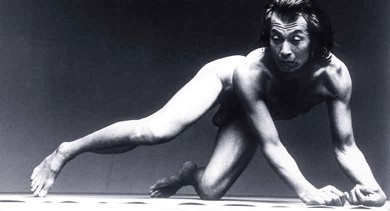
Min Tanaka at PS1. I'd never seen him live, but loved his performance in the film Tasogare Seibei (The Twilight Samurai) so I thought I'd head out to Queens. Was not crazy about this performance alone (which essentially consisted of sitting in the whipping cold attic of PS 1 while Tanaka rocked, writhed and convulsed like an Alzheimer's patient for 45 minutes); however the meal afterwards was definitely worth it.

Lulu at BAM. The Wedekind play about the life and descent of a woman who employs herself and body as a commodity. Hmm. Best thing in it was the huge white wall that started far upstage and almost unnoticed advanced incrementally throughout the play so that by the last scene, it pressed the actors practically up against the audience.


---

2007, what a wild year. All-in-all, the general level of activity was very intense. I'm feeling a bit jaded about theater. My top 3 will be pretty quick:

3. Bobby's Yudkowski Returns! (at the Brick) was a real surprise and a real joy to watch.

2. Young Jean's Church (at PS 122) -- I haven't laughed that hard in the theater in a really long time.

1. TR Warszawa's KRUM (at BAM) sincerity in the theater still exists, thank you very much. What I felt as a truthful portrayal of all the anticlimaxes of life and the fantasies needed to sustain them.

---

I did enjoy many more movies this year, and by far my favorite was the Coen Bro's No Country For Old Men. The story is framed by Tommy Lee Jones' narrator character who is an (old) man who expects the world to function according to societal consensus and order, and the antagonist murderer played by Javier Bardem who is a man who imposes his own order upon the world which he knows to be without. Thrilling to the end.

Monday, November 19, 2007

The REAL popular theater


I saw something a few weeks ago which amazed me to such an extent that even after 2 weeks I'm still not sure I can convey the complexity of the event.

My co-worker and longtime friend Nyan-nyan-chan took a few (well-deserved) days off of work. I assumed that he was just going to be holing up at home with some pornos, as is his habit, but in fact he was working on a show from Japan. He kept referring to it as 大衆演劇 "popular theater" of the worst kind, and coming from him, who most of the time LOVES the razzle-dazzle simple pleasures of spectacle in entertainment for the masses, that was saying a lot.

Let me backtrack a little bit and say that in my academic studies of theater, in the early to mid-1990s, we meticulously followed the course of popular theater across culture and throughout human history. Theater has historically been a dirty low-class business, hardly a step away from prostitution. Certain rulers, patrons and artists were able to elevate theater and promote it as an intellectual and artistic endeavor, but its populist roots were deep. And so it was in Japan. The first appearance of the seeds of traditional theater were in sarugaku, a form of song and dance. Originally women performed by the riverbanks in the outskirts of town -- but because this entertainment was so deeply tied to prostitution, women were banned from performing. Out of sarugaku arose what has come to be known as noh theater (the solemn, serious, mystical heavy slow drama, performed with droning chants and jolting percussion-heavy music, and masks) and kyogen, noh's comic cousin, much akin in form and content to commedia dell'arte. Now, after several hundred years of codification of the physical training and staging, both noh and kyogen are treated with great reverence as an irreplaceable relic and living cultural treasure. But when you think about it, hundreds of years ago, the Lords of feudal society were paying for noh and kyogen actors to entertain them.

So if noh & kyogen (and kabuki) as we know them today have tracked the trajectory of the "high" art in terms of fidelity of principal and construction, custom and systemic rituals of the form, then where has the spirit of popular theater gone?

Well not to fret, it is alive today, tottering on shaky legs, in Sawa Ryuji, The Return. Sawa Ryuji is an old school populist actor. He and his "school" of theater is precisely that of popular theater. It is about entertaining the masses, it's about spectacle and drama (laugh and cry, and catharsis). So for its value as a cultural phenomenon alone his show was worth seeing.

As for the show itself... There is no way for me to aptly describe what it was, but let me try. Imagine a showcase/revue, a sequence of vignettes, scenes, dances and songs, featuring a variety of performers playing a variety of different roles. The main actor is a middle-aged (50s?) man who's like a cross between Tammy Fae Baker and Bruce Willis. He performs ridiculously choreographed stylized sword fights in which he defeats legions of enemy without ever getting within 3 feet of them. Every time he makes an entrance, an MC on mic announces his name over the blown-out PA system, and the audience is supposed to shout his name and cheer him on. He appears in vignette after vignette, with minimal dialogue and maximum maudlin melodrama and cheap spectacle, and there is a perpetual spotlight on him, no matter where he is on stage. In the finale, he comes out in an emerald green sequined Japanese gown, and sings a song about how there's only the actor's life for him. He is sweaty, wobbling into the house (full of Americans who haven't understood a word he has said throughout the evening, and probably think this is "great exotic Japanese performance"), and full of pride. At the curtain call, he attempts to introduce some of the long-time actors in his company, but he can't remember their names. Ah, the irony, the poignancy, the heartbreak...

Monday, November 05, 2007

The mythologies of John Moran (and his neighbor Saori)


When I first ever saw a work by John Moran, it was at the Kitchen, and he had just gone through terrible heartbreak. After his long-time German (I think?) partner and girlfriend left him, he incorporated the sad event into his lush looping Goldberg Variations, weaving this beautiful wistful story of loss through seamlessly interwoven and looping soundtracks and choreography. That was the first time Saori worked with him, and whatever conflicts or dramas they might have had, together I think they are wonderful artistic collaborators.

Their latest at PS122 was not really about (as the titles of the piece suggested) what if Saori had a party? but it was instead a rather dark meditation on mortality and loss of innocence. The top of the show introduces Saori as a super-cute robotic anime-type character who lives in a bubble (think Astroboy + Teletubbies + Twiggy x a dose of acid). She is "not real" as she admits, and desires nothing more in the world than "to exist" (i.e. be real). Her companion, Mr. Computer (which is just the voice of a talking mac) informs her that today, somehow, her wish can be granted -- today is her first ever birthday. A singing telegram man shows up with a surprise birthday present -- which turns out to be a baby. Saori must then learn to take care of this baby, who fusses and cries, and repeatedly goes through a cycle of "growing up." Eventually in an effort to understand why the baby suffers, and what loss means, Saori is burst out of her bubble and experiences the suffering of life first-hand, all the way to death. It's a poignant Pinocchio story without glorious salvation or redemption. Though it never reaches the depths of grotesqueness and despair that compares to the height of its saccharine sweetness, Saori's Birthday was still a great display of Saori's phenomenal physical control and grace of movement, Katie Brook's precision and sweetness, Joseph Keckler's awesome singing voice and John's deeply emotional sound-score that spirals the audience into intimate moments of vulnerability.

Friday, November 02, 2007

Dan in Real Life is not real


I heart Steve Carell, OK, I'm sorry, but that is just the bottom line for me. So, yes, I WILL drag my boyfriend to see a dumb romantic comedy-type movie just to see Steve on screen for an hour or two. Dan in Real Life, for which I had low expectations, was pretty much as I thought it would be, nothing more, nothing worse. It was definitely one of those movies (like Little Miss Sunshine) that comedy actors tend to make when they want to expand their "range" like The Truman Show and Eternal Sunshine for Jim Carrey (pretty great movies), or The Final Cut and One Hour Photo and Insomnia for Robin Williams (all terrible). But Steve was pretty understated, believable and sympathetic as the widowed father of three pre/pubescent daughters. Much was unbelievable in the premise of the movie (the whole falling in love with the psycho woman (Juliette Binoche) in the bookstore who babbles on endlessly, her falling for him, I mean essentially the whole darned plot) but really, who cares. Diane Weist plays Steve's mom [Irwin: She looks so OLD!!!]. Not really sure who this movie is FOR. I mean, besides Steve Carell fans.


Monday, October 29, 2007

Darjeeling Limited


All the urban hipsters love Wes Anderson, and I loved him too -- Rushmore was a really great film. But after awhile, the same gimmicks wear a bit thin. The slo-mo sequences with emotive music, the flat line-deliveries resulting somehow in moments that are meant to be poignant. Darjeeling Limited was yes, cutesy as I expected it might be. Two troubled brothers are summoned by their third (and eldest) to join him on a mysterious trip through India for the purposes of brotherly-bonding, soul-seeking, and, most importantly to find their estranged mother who has long ago become a missionary-nun in the foothills of the Himalayas. The first two-thirds of the film this journey proves to be a bumbling disaster with such antics as the train getting lost, and the brother getting kicked off the train. While seeking an alternate mode of transport, they come upon thee young Indian boys (presumably brothers) who are trying to cross the river with a load of supplies, but their raft is overturned. Our three protagonists jump into the river to try to save the young boys, but their efforts are not wholly successful in the wild torrents of the river: Adrian Brody emerges from the river with a dead Indian boy in his arms. From there, the three somehow (finally) connect with each other, and also reconnect with the memory of their father's death. The funeral rituals, because of their foreign-ness, are profound and beautiful to the three. They emerge having come together, having learned something intangible about brotherhood and humanity, even if on a small scale.

Honestly, it is a cute movie and everything, but the more I think about it, the more I feel like it's such a WHITE movie, as in the kind of film only a white person could make. The whole exploration of what the filmmaker and the protagonists find exotic/foreign/fascinating is not without the acknowledgment of objectification -- but for their spiritual epiphany to be triggered at the expense of the life of a young Indian boy, to me was rather cheap and exemplary of the whiteness of the movie. And I'm not even a hardcore PC racism-patroller or anything.

Punk Kabuki


An unlikely marriage, I know, but Brendan Connelly (composer) and Brooke O'Harra (director) make Drum of the Waves of Horikawa a wild ride throughout. The 18th century kabuki play by Chikamatsu in Donald Keene's translation is electrifyingly alive in the mouths and bodies of this crack team of performers who fully embrace the thrash-mosh energy of Brendan's moody punk-ish compositions. I was particularly impressed by Heidi Schreck -- who I'd seen in several other shows -- and thought this was the best work she's done, and that she really carried the show from each gyration to the next cross-eyed grimace. I'm not sure it needed to be 2 hours long (five episodes) and towards the end, especially after Schreck's character is beheaded, the drive to the end lags a bit. Also noteworthy were all the design elements by regulars of Theater of a Two-Headed Calf, Emily Rebholz' costumes, Justin Townsend's lights, and Peter Ksander's set -- I think half the plays I see have sets by Peter, his designs are always exciting, creative and very specific. Check out the toilet-plungers.

Friday, October 26, 2007

Boyfriend in a coma I know, I know


I'd heard of playwright Jason Grote quite a bit so when I got a notice about his latest play 1001 at the Baruch Performing Arts Center, I decided to go without even really researching what the play was about. Grote has a very ambitious play on his hands, many things that are challenging and work to varying degrees of success. From the lobby entrance to the theater, audience members are given a colored coupon and told to follow along a colored line (corresponding to the color of their coupon) taped to the floor. The lines diverge and snake along the perimeters of the theater and end up in different point of the playing space. A cute device that demonstrates very literally that divergent paths can still lead to the same center. The play itself, staged in the round (or square, as it were) follows a similar structure: several storylines (some more leading than others) intertwined, with the two protagonists finding each other in a love relationship that spans different eras, mythologies, times and spaces. They are Scheherazade and the Persian king (the framing story of Arabian Nights), they are also a contemporary young couple in New York (one an Arab and the other a Jew) who end up suspended in limbo when the next war/terrorism strikes NY and the guy gets bricked in the head and ends up in a coma. The other handful of cast members play a multitude of characters from rivaling romantic interests to Scheherazade's sister, even Gustave Flaubert and Jorge Luis Borges make appearances -- and though this smorgasbord of characters and settings seem intended to create a complex vortex of many disparate stories converging into one, there is something forced in the script and direction that makes it very apparent what the play is up to -- its edge is never quite sharp enough to really surprise or enchant. The cast is limber and versatile, and there are some very effective moments in the play. The live dj running the sound and projected text (for scene titles and once an on-line chat-love-scene) gave the production an air of hipness that didn't quite mesh -- it may have had something to do with the lead actor Matthew Rauch, who I've seen in a bunch of show -- or maybe it was just Red Bull's The Revenger’s Tragedy which for some reason I found so banal -- who is like "a very good actor" type and drives me crazy. The play actually reminded me of that movie The Fountain, in that they both were attempting to weave a timeless (or rather trans-temporal) epic love story but didn't quite keep it together. The Fountain was more beautiful, 1001 was more convincing, but both were kinda cheesy.

Tuesday, October 23, 2007

FOOD COMA!!!!!


Ivo Van Hove, why do you hate playwrights so much? Why do you hate Americans so much? And why do you hate actors? The Belgian director is at NYTW once again, making aping idiots of us all, with the unlikely The Misanthrope -- yes Moliere's. Much fuss has been made about Van Hove, who undoubtedly has a unique vision and great aesthetics. The designs of his shows are what are most notable -- always a stark, bold, clean canvas upon which he smears the filth of humanity. In this case, food. The original play is about Alceste, an all-or-nothing kind of guy, morally speaking. He can't accept anything less than the honest-to-God brutal truth, and abhors the convention of manners and politeness -- and yet he is in love with the most superficial socialite around. About 20 minutes into the piece, Alceste rudely interrupts his acquaintances' lunch spread from the deli by laying his body on top of the picnic. He then proceeds to drench himself in chocolate syrup, catsup, jam and anything else he can get his hands on, in a gesture meant to demonstrate in graphic terms the true disgusting animal face of mankind. It certainly effective in invoking revulsion, especially with the stench of all that food permeating the theater (later, with the flinging of sour cream and tomato sauce pretty much covers all the bases in terms of olfactory overload). Unfortunately this big mess does little to elucidate the play. Grossly miscast and with no attempt to actualize the characters the way Moliere wrote them, Van Hove's intention weighs heavily atop the actors like an old stinky rag and the dramatic structure splinters with each passing moment, despite the intricate and innovative video work and heated performances.

Thursday, October 18, 2007

This Krummy Life


I wish I knew what kind of name "Krum" is in Polish. Does it feel like "Jim" or more like "Anderson"? I can only guess it feels just as it sounds, Krum -- crumb, crumble. The Polish company TR Warszawa was at BAM with New York premiere of Krum by the late Israeli playwright Hanoch Levin. When I walked into the Harvey, the set, to me, felt like a David Lynch space. Latticed wood floor, walled in perimeters with windows, heavy curtains, lush green/red/blue thick velvet fold-out train beds, a few banks of heavily cushioned theater seats and a projection screen hung in the center of the space. Combined with the incessant (I mean truly, relentless and endless) score of trancey lounge music underscoring the play, it felt, initially, as if a dancing dwarf was going to crawl out of a hole in the ground, or a voluptuous naked lady was going to writhe about in pain in the corner.

What ended up transpiring on stage, over the next near three hours, was something quite different. Somehow evoking Hamlet, Woyzek, Trainspotting, and Naked (Mike Leigh's) all at the same time, here is a story about the futility and wonder of life -- trainwreck marriages (and great ones), diseases, desire, disappointment, fantasies, mutating definitions of success, and death -- the things that humans living in society are all supposed to experience. The desire for and the impotency in rebellion against those things, in the raging attempt to "get out of here."

Krum comes home "from abroad" (though God knows where he's been) decidedly without any gifts or stories. The one thing he has accomplished, he announces proudly, is to avoid getting married. He comes home to his mother, who, like any mother, wants him to live (i.e. make some money at some job, marry a girl and produce offspring). And for the following many years that unfold, everyone around his life does just that. All of this living is happening (albeit painfully, albeit glumly) and Krum alone stands to the periphery of it all, the perpetual observer. Years pass, and his mother still implored him to get a life, but he refuses -- he is a writer, and artist, and cannot be bothered with those kinds of things, and he has just begun (finally) his new novel... and he is still chasing after some impossible fantasy.

It's hard to imagine the portrayal of such a glum existence and environment is pulled off without making the audience want to hang themselves -- but the inventive stage compositions with occasional video montages of modern-day Israel and live feed from the stage, and the rough edges, raw energy, and extreme emotional commitment of the performers, bring incredible amount of compassion and life to a play about how life is meaningless.

about a girl...


...who finds her true self in deceipt

me
: I saw lust caution by the way
1:11 PM alannalanners: oooh, what did you think?
me: i thought it was a pretty great movie,
i didn't feel the same way you did about the first half being hollywood war movie
also, so many pp had talked to me about the sex, that it didn't seem so intense to me
but i enjoyed it...
1:12 PM i liked how it was about this young girl learning how to engage with the world and find an identity through "performance"
but that in the face of the guy, in the bedroom, the rules were different
alannalanners: yeah, it's interesting. i think the way it ends is pretty great
1:13 PM me: i felt like it was about her journey to grasp what is REAL in life
i also liked how she went from being so naive
1:14 PM god,
it was so painful to watch her set the standard for loyalty
when she didn't really know ANYTHING
alannalanners: yeah, it was painful
1:15 PM i thought at the end you'd just hear she'd been killed, so it was surprising and pretty cool to see her lined up with the whole gang at the end....she took them all down in a way
1:16 PM i was a little confused by the whole diamond thing though...did you feel like the gesture of him giving her the diamond really signified some kind of true love for her?
1:17 PM me: no not love
but yeah the diamond was weird
but i think irwin put it in a really great way
that she had been able to connect with this monster
in his deepest surviving HUMAN part,
and that that connection was a REAL thing,
1:18 PM and that the diamond symbolized like in actual physical terms
the realness of that connection
and that was when she realized she could not betray the one thing she felt as real
alannalanners: yes, that's eloquent
that makes sense
1:19 PM cause at the time part of me was like "come on girl that's just a big ole cheesy diamond"
me: right right
that's what i thought too
because "ring" just implicates all this other stuff about love & marriage
1:20 PM alannalanners: yeah
1:22 PM me: hey can i rip off this chat session and post it on my blog?
alannalanners: sure dollface

Tuesday, October 16, 2007

i didn't get it


I'm assuming nobody reads this blog, really. Except for sometimes Irwin and Kayoko, maybe Maha. Which is fine, because I can dare to be honest and stay in the habit of writing down my thoughts.

On Monday night I went to see the opening of John Jesurun's Philoktetes. John is really famous. He was a recipient of one of them Macarthur GENIUS awards, and he is something of a downtown theater icon-legend. The theater was packed with the downtown crowd. Young Jean Lee was there (hadn't seen her since Vienna), Mallory, Brooke O'Harra, the redhead dude from Wooster group, actors, directors, designers, auteurs. Boy there is nothing like a room of theater artists that makes me want to run away screaming. I mean, it's not that I don't like them, I actually do like them quite a bit. But you know. I feel self-conscious in those situations.

The set was simple and elegant. Projection surface covering a large square on the floor, and also a screen suspended at an angle from the sky -- both projection surface displaying (for most of the time) the same moving images of crashing waves/liquid cloudy skies, rustling green forest, etc. Also there was a camera set up upstage center, which could supply live audio and video feed to the suspended screen. Sometimes actors would go up there, and their faces would fill the entire screen. The actors were more than competent -- grounded and limber with the dense text.

So what was my overall experience of the show? I didn't get it. I'm sorry. I don't know why the script jumped around so much from that dry historical tone in one moment, to super colloquial the next ("What does he look like?" "His face is like an aubergine dressed in garlic sauce."); I didn't know why everything was delivered in this deadpan way, and then suddenly, for reasons not easily discernible to me, jolt into a hyper-emotive moment (an attack, a kiss, a shouting match); I don't know what the story was about and why it mattered at all. This style of detached theater seems to be all in vogue this decade, and I feel like an old fuddy-duddy but I have to admit I just don't get it. Like Richard Maxwell's stuff? (Ironic humor at the expense of the characters -- wait make that a triple dose of irony) And the Wooster Group's stuff as well. That accentuated separation between text and intention and movement -- it seems more impotent rather than powerful, in the contexts of their work. Someone enlighten me.

Monday, October 15, 2007

the grotesque


The two Dairakudakan Kochuten shows at work got great notices in the press, but frankly I wasn't thrilled. Maybe because I remembered their previous visits to New York so vividly. Back in 2002, they dropped into a sweltering New York summer for a series of shows that were totally fascinating, fun and exciting. There was a parade of men with sausages sticking out of their thongs -- and a hag-demon who cut off their "phalli" and weighed them on a scale, cackling; there was an underground society of creatures who sawed off their the crown of their victim's skull and ate his still-living brain; a strange slo-mo wedding procession complete with accompanying horses and stolen kisses to Andrea Bocelli's Time to Say Goodbye. Deliciously kitschy stuff.

Their latest pieces, Tiger's Cave and Yupiters did not captivate the way the other pieces did. The all-male Tiger's Cave, created by Kumotaro Mukai, was a comic imagining of a training camp for butoh dancer. An air of austerity, discipline, and asceticism is disrupted when one of their fellow trainees (or is it a teacher?) returns from a journey abroad sipping a cup of espresso and bearing gifts: a flag of France, a baguette, a pair of salt and pepper shakers, and a whip. His sauntering in to the theme song from The Triplets of Belleville infects the group and soon they've all given up the rigid butoh life for the Parisian one. At the height of this joyous revelry, the phone rings. With trepidation one of them answers. Whatever he hears on the receiver is enough to render him paralyzed and speechless. He hands the phone off to another trainee and the same thing happens to him. The third guy is finally able to spit out the words in terror: "CLEAN UP!" The pupils scamper around to destroy any evidence of their moment of fun to greet the return of their next teacher: a man/horse whose limbs are balanced precariously on the traditional Japanese laquerware. He clomps about noisily and wears a bizarre bit-like brace in his mouth that keeps his teeth perpetually bared. And so it goes on for a while. The concept is not uninteresting, but it was the indulgence and pacing that killed it for me. A reminder that what makes for a stunning picture cannot hold its own without a smart sense of time and timing.


Yupiters, the all-female companion piece by Yuko Kobayashi, proved to be much more esoteric. An ethereal trance-like landscape of ever-shifting images. The ensemble of women transformed themselves time and again, with elaborate costume changes and with extraordinary contortions. Gigantic fishbowls (with live fish) dangled from the sky. Mirrored panels surrounded the gathering, undulating wildly, creating an overload of visual information. The climax of the piece in which Kobayashi, painted entirely in silver, is surrounded by a throng of village women who prod and provoke her (without ever really touching her) and she is left to spasmodically churn and convulse, much like a fish out of water. For all its intensity and spectacle, this piece, too, left me feeling rather unmoved. Like eating at a super-fancy restaurant -- each dish looks so gorgeous, but does little to actually satisfy your hunger.

In the middle of the run I went to see the Red Bastard at the Brick Theater's NY Clown Festival. It was the 3rd time I'd seen him. While he certainly hit the mark I couldn't help but feel like he was under the weather, because he didn't wrangle his audience with the nonchalant ease with which I've seen him do so in the past. Nonetheless, he remains one of my favorite performers of that ilk -- if you've never seen him, you must, you must, you must.

Monday, October 08, 2007

what will happen to the kids?


Lloyd Suh's latest play, The Children of Vonderly, produced by Ma-Yi, is a story about an unusual Midwestern family of disabled people of all kinds of background who were adopted by the Jewish couple the Vonderlys, and what happens when the patriarch of the family dies. Well, what happens is, the widowed mom goes batty, the mentally impaired "kids" are left to fend for themselves while the physically impaired (but lucid) siblings fall in love with each other and run away -- or at least try to. The children of the Vonderly household are no longer children, really, so the play is really about their struggle for independence and their pursuit of happiness. It's a theatrically conventional play, but very well-acted all around. But I can't help feeling like the metaphor of the play was somehow being obscured by all the good acting, uber-realistic speech patterns, and set changes executed by stagehands in black. I mean, this play isn't really about disabled people and their struggle for independent lives, is it? It seems like if that were the point, the play should have been cast with actors who were actually disabled -- all actors were decidedly NOT disabled (as evidenced by their quick transitions in blackouts) except for Stephen Jutras who is a dwarf. Towards the end of the play, the writer (and the protagonist) seemed more interested swimming in the slick banter than actual catharsis or change.

Friday, September 14, 2007

Theater of the Imperfect and Impossible


The thing that drives me crazy about theater/live performance, is that it is inherently NEVER PERFECT, or rather, it highlights and revels in everything that is imperfect about being human. Of course this is where the beauty of performance lies as well -- spaces between the elements/layers that allow room for spontaneous, magical experiences. Performers hit the stage every night with a different body, a different energy, and a different audience; even within a set structure the event that coalesces can blossom into a different creature every time.

But then there is the grappling with the impossible, that can cause someone like me to develop an ulcer or burst a blood vessel in my head.

Basil Twist's Dogugaeshi is one of those shows that valiantly and beautifully wrestles with the imperfect that verges on the impossible. Commissioned by Japan Society, it premiered there in 2004, and it's back for a remount before it tours to Japan next month. It is, hands down, a unique show and beautiful -- comprised of probably about 100 gorgeously painted sliding screens set in complex systems of frames, Twist as his 3 puppeteers unravel a journey of images from old and new Japan. Once in a while a white fox puppet appears and interacts with the sliding and dividing pictures adding a lot of charm to the piece (interesting to note the audiences need/desire for a recognizable "character"). It is not only constantly changes images, though, that inspire awe. The multi-layered soundscape full of fun, surprising montages and live shamisen/koto improvisation by Yumiko Tanaka (amazing woman) and the elegant projection design (Peter Flaherty, who seems to have a monopoly on this kind of work) work in confluence with the screens for this potentially mind-blowing experience.I say potentially because, well, it is clear, without a doubt, that this is a very special, unique work of art, but having seen probably a dozen performances of it, I don't think I've seen it executed perfectly. And ok, so what is "perfection" in this kind of work? For one thing, the physical execution of a very complex sequence of moving objects. It is a fact that physical objects are clumsy. But, unlike the volatile energy and emotional states of a living breathing actor, the objects' characteristics are more predictable and reliable and consistent. So on one hand it seems perfectly possible to expect inanimate objects to achieve perfection in a way that living breathing humans cannot.

Actually in the week it's taken me to write this darned post, the show has really blossomed -- as if these painted panels are now breathing. Pretty darned amazing. Showing for two more nights. Sold out, but you should try to get waitlisted.

Wednesday, September 12, 2007

wade in retards


Fall is officially upon us. I need a light jacket or sweatshirt now. And the performance season has commenced. Which means a lot of manic running around for me.

To kick off the fall, I was fortunate enough to see Jeremy Wade's latest -- a group piece (a quintet to be precise) from the Bessie-winning American choreographer based in Berlin: ...and pulled out their hair at Joyce Soho. Apparently this piece was originally slated for PS122 but for unclear reasons made the move to Soho instead.

The first five minutes of the piece absolutely thrilled me.

When we walked in, there was one man standing on the white marleyed, white-walled stage. He was a rather big man, a rugged handsome type, dressed in a white short sleeve button-down shirt and black tie and slacks. He stood at the edge of the marley and surveyed the audience coming in with shifty eyes, twitching shoulders, and insipidly creepy grin. At times convulsing, and other times leering, he was the very image of a barely checked homicidal child molester or a developmentally impaired sexual deviant of some sort. After a while, 4 others entered upstage left, stumbling haltingly. Those were two women (in short black skirts and white blouses) and two men (in white button-down short sleeves, black shorts and suspenders), all, like our first man, somehow not completely in control of their physical and mental faculties. The group altogether seemed to form a school or society of degenerates, indeed, a grotesque portrayal of our own culture.

Throughout the course of the piece, this team of squealing, drooling freaks tumbled, stumbled, clambered, wrestled, fought, fucked, sniffed and embraced each other, at times demonizing, and at others, coddling each other -- as if they were the purest representation of the human id, bursting with uncontrollable desires. At one point, the performers faced the audience in a line and opened up their faces to an extreme. And their faces remained that way for the rest of the performance, suspended in a state of total shock or an unending yawn or expression of utter vapid idiocy, depending on what you wanted to see. After a while I began to see their wide-open saliva-secreting mouths as body parts as intimate as flowering anuses -- in fact the whole performance seemed to be some twisted inversion of the order imposed on us writhing breathing wild humans by the system we call society.

Though unlike much dance I see this work was very dramatic (in terms of describing a sequence of events and interactions amongst people), it somehow lacked a rhythmic drive to pull the audience from one excruciating portrayal of the human condition to the next. Clocking in at just under an hour, it presented a rich if a bit tired (and very very sweaty) view of human nature.