Showing posts with label film. Show all posts

Monday, December 24, 2007

Catching up, and the TOP 3 of 2007

YIKES! I haven't posted anything in so long, even though I've seen tons of shows and movies.

Here's a super quick run-down of some stuff:

Harry Partch's Delusion of the Fury at JS. Ambitious and interesting concept, but not really a theatrically watchable piece. Best part, besides Partch's original instruments, were John Jesurun's projections on the ceiling of the theater.


Saga Theater's Homesick at the OHIO. A physical and musical ensemble play about search for community and identity and an indictment of greed. A lot of material generated over the company's 3.5 week rehearsal process, with much more exploration and sculpting to be had.

The Baby Jesus One-Act Jubilee: The Second Coming at the Brick. A series of ten-minute plays loosely about Christmas and Christ-related themes, for the most part hugely ironic. I only caught the Josephs. Highlights: Joseph is a single dad looking for a wife and mother to his son Jesus, but Joseph is also afraid of sexual intercourse since it led to the death of his first wife, Sheila, during childbirth (what??). Or the play about finding out your ex-girlfriend is now a dyke, at or around Christmas time. I had a cup of the theater's rum-heavy hot cider before the show, so it was hard for me to stay awake...

Pappa Tarahumara's Ship in A View at BAM. I AM biased -- Pappa T is one of my favorite companies ever, of all time. Their combination of visceral imagination, stunning stage, light, and sound designs, unparalleled dancers and singers are something to behold. This particular piece, though, was not my favorite. It was dragging in tempo and the transformations seemed murky.
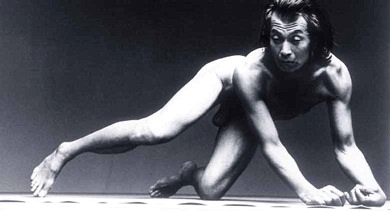


Min Tanaka at PS1. I'd never seen him live, but loved his performance in the film Tasogare Seibei (The Twilight Samurai) so I thought I'd head out to Queens. Was not crazy about this performance alone (which essentially consisted of sitting in the whipping cold attic of PS 1 while Tanaka rocked, writhed and convulsed like an Alzheimer's patient for 45 minutes); however the meal afterwards was definitely worth it.

Lulu at BAM. The Wedekind play about the life and descent of a woman who employs herself and body as a commodity. Hmm. Best thing in it was the huge white wall that started far upstage and almost unnoticed advanced incrementally throughout the play so that by the last scene, it pressed the actors practically up against the audience.


---

2007, what a wild year. All-in-all, the general level of activity was very intense. I'm feeling a bit jaded about theater. My top 3 will be pretty quick:

3. Bobby's Yudkowski Returns! (at the Brick) was a real surprise and a real joy to watch.

2. Young Jean's Church (at PS 122) -- I haven't laughed that hard in the theater in a really long time.

1. TR Warszawa's KRUM (at BAM) sincerity in the theater still exists, thank you very much. What I felt as a truthful portrayal of all the anticlimaxes of life and the fantasies needed to sustain them.

---

I did enjoy many more movies this year, and by far my favorite was the Coen Bro's No Country For Old Men. The story is framed by Tommy Lee Jones' narrator character who is an (old) man who expects the world to function according to societal consensus and order, and the antagonist murderer played by Javier Bardem who is a man who imposes his own order upon the world which he knows to be without. Thrilling to the end.

Friday, November 02, 2007

Dan in Real Life is not real


I heart Steve Carell, OK, I'm sorry, but that is just the bottom line for me. So, yes, I WILL drag my boyfriend to see a dumb romantic comedy-type movie just to see Steve on screen for an hour or two. Dan in Real Life, for which I had low expectations, was pretty much as I thought it would be, nothing more, nothing worse. It was definitely one of those movies (like Little Miss Sunshine) that comedy actors tend to make when they want to expand their "range" like The Truman Show and Eternal Sunshine for Jim Carrey (pretty great movies), or The Final Cut and One Hour Photo and Insomnia for Robin Williams (all terrible). But Steve was pretty understated, believable and sympathetic as the widowed father of three pre/pubescent daughters. Much was unbelievable in the premise of the movie (the whole falling in love with the psycho woman (Juliette Binoche) in the bookstore who babbles on endlessly, her falling for him, I mean essentially the whole darned plot) but really, who cares. Diane Weist plays Steve's mom [Irwin: She looks so OLD!!!]. Not really sure who this movie is FOR. I mean, besides Steve Carell fans.


Monday, October 29, 2007

Darjeeling Limited


All the urban hipsters love Wes Anderson, and I loved him too -- Rushmore was a really great film. But after awhile, the same gimmicks wear a bit thin. The slo-mo sequences with emotive music, the flat line-deliveries resulting somehow in moments that are meant to be poignant. Darjeeling Limited was yes, cutesy as I expected it might be. Two troubled brothers are summoned by their third (and eldest) to join him on a mysterious trip through India for the purposes of brotherly-bonding, soul-seeking, and, most importantly to find their estranged mother who has long ago become a missionary-nun in the foothills of the Himalayas. The first two-thirds of the film this journey proves to be a bumbling disaster with such antics as the train getting lost, and the brother getting kicked off the train. While seeking an alternate mode of transport, they come upon thee young Indian boys (presumably brothers) who are trying to cross the river with a load of supplies, but their raft is overturned. Our three protagonists jump into the river to try to save the young boys, but their efforts are not wholly successful in the wild torrents of the river: Adrian Brody emerges from the river with a dead Indian boy in his arms. From there, the three somehow (finally) connect with each other, and also reconnect with the memory of their father's death. The funeral rituals, because of their foreign-ness, are profound and beautiful to the three. They emerge having come together, having learned something intangible about brotherhood and humanity, even if on a small scale.

Honestly, it is a cute movie and everything, but the more I think about it, the more I feel like it's such a WHITE movie, as in the kind of film only a white person could make. The whole exploration of what the filmmaker and the protagonists find exotic/foreign/fascinating is not without the acknowledgment of objectification -- but for their spiritual epiphany to be triggered at the expense of the life of a young Indian boy, to me was rather cheap and exemplary of the whiteness of the movie. And I'm not even a hardcore PC racism-patroller or anything.

Friday, October 26, 2007

Boyfriend in a coma I know, I know


I'd heard of playwright Jason Grote quite a bit so when I got a notice about his latest play 1001 at the Baruch Performing Arts Center, I decided to go without even really researching what the play was about. Grote has a very ambitious play on his hands, many things that are challenging and work to varying degrees of success. From the lobby entrance to the theater, audience members are given a colored coupon and told to follow along a colored line (corresponding to the color of their coupon) taped to the floor. The lines diverge and snake along the perimeters of the theater and end up in different point of the playing space. A cute device that demonstrates very literally that divergent paths can still lead to the same center. The play itself, staged in the round (or square, as it were) follows a similar structure: several storylines (some more leading than others) intertwined, with the two protagonists finding each other in a love relationship that spans different eras, mythologies, times and spaces. They are Scheherazade and the Persian king (the framing story of Arabian Nights), they are also a contemporary young couple in New York (one an Arab and the other a Jew) who end up suspended in limbo when the next war/terrorism strikes NY and the guy gets bricked in the head and ends up in a coma. The other handful of cast members play a multitude of characters from rivaling romantic interests to Scheherazade's sister, even Gustave Flaubert and Jorge Luis Borges make appearances -- and though this smorgasbord of characters and settings seem intended to create a complex vortex of many disparate stories converging into one, there is something forced in the script and direction that makes it very apparent what the play is up to -- its edge is never quite sharp enough to really surprise or enchant. The cast is limber and versatile, and there are some very effective moments in the play. The live dj running the sound and projected text (for scene titles and once an on-line chat-love-scene) gave the production an air of hipness that didn't quite mesh -- it may have had something to do with the lead actor Matthew Rauch, who I've seen in a bunch of show -- or maybe it was just Red Bull's The Revenger’s Tragedy which for some reason I found so banal -- who is like "a very good actor" type and drives me crazy. The play actually reminded me of that movie The Fountain, in that they both were attempting to weave a timeless (or rather trans-temporal) epic love story but didn't quite keep it together. The Fountain was more beautiful, 1001 was more convincing, but both were kinda cheesy.

Thursday, October 18, 2007

about a girl...


...who finds her true self in deceipt

me
: I saw lust caution by the way
1:11 PM alannalanners: oooh, what did you think?
me: i thought it was a pretty great movie,
i didn't feel the same way you did about the first half being hollywood war movie
also, so many pp had talked to me about the sex, that it didn't seem so intense to me
but i enjoyed it...
1:12 PM i liked how it was about this young girl learning how to engage with the world and find an identity through "performance"
but that in the face of the guy, in the bedroom, the rules were different
alannalanners: yeah, it's interesting. i think the way it ends is pretty great
1:13 PM me: i felt like it was about her journey to grasp what is REAL in life
i also liked how she went from being so naive
1:14 PM god,
it was so painful to watch her set the standard for loyalty
when she didn't really know ANYTHING
alannalanners: yeah, it was painful
1:15 PM i thought at the end you'd just hear she'd been killed, so it was surprising and pretty cool to see her lined up with the whole gang at the end....she took them all down in a way
1:16 PM i was a little confused by the whole diamond thing though...did you feel like the gesture of him giving her the diamond really signified some kind of true love for her?
1:17 PM me: no not love
but yeah the diamond was weird
but i think irwin put it in a really great way
that she had been able to connect with this monster
in his deepest surviving HUMAN part,
and that that connection was a REAL thing,
1:18 PM and that the diamond symbolized like in actual physical terms
the realness of that connection
and that was when she realized she could not betray the one thing she felt as real
alannalanners: yes, that's eloquent
that makes sense
1:19 PM cause at the time part of me was like "come on girl that's just a big ole cheesy diamond"
me: right right
that's what i thought too
because "ring" just implicates all this other stuff about love & marriage
1:20 PM alannalanners: yeah
1:22 PM me: hey can i rip off this chat session and post it on my blog?
alannalanners: sure dollface

Tuesday, August 28, 2007

What Remains

It's been years, maybe even 8 or 9 years, since I went to a NY Fringe Festival show -- in fact I had pretty much forgotten about it altogether, but Banana was in a Fringe play so I went to see it, and I was surprised to discover that I knew several people involved in the production.

Inspired by the late great Ingmar Bergman's film Cries & Whispers (which I have not yet seen), what remains is the (stillness) of objects co-directed by Jill Samuels and Hillary Spector was an admirable homage-in-progress to the Swedish filmmaker and his brutal-beautiful modes of story-telling. The most successful way in which stillness captured the essence of cinema was its ingenious set designed by Paul Hudson. Between the audience and the performers/performance there was erected a wall comprised of lush red square panels, maybe 16 in all. These panels were suspended on a system of zipline tracks, and were easily manipulated to slide laterally by the performers. Through the carefully timed choreography, these panels slid from side to side, opening and closing windows into the action, replicating, as it were, an amazing experience of camera frame. The opening shot -- a wide angle shot of a bed-ridden woman struggling against the pain of disease and impending death. The bed moved from upstage to downstage, that is, from far to close to the red frame, creating the effect of the camera zooming in on the claustrophobic sickroom. These successive "shots" created by the shifting of panels were some of the most inventive devices I'd seen in a long time. Especially because then you could break the rules to do thing you can only do in the theater. For example, as two sisters have tea while discussing their 3rd sister's failing health, one of the women ever so casually drapes her wrist over the edge of the red frame -- and with that singular and simple gesture, pointing to the fragility of the rules of this world, and the inevitable fracture of normalcy that was to come.

Ironically enough, however, the astonishing creativity of the set design quite overshadowed the actual content of the play. The story vaguely follows the nuanced dynamics of two sisters waiting for their 3rd sister to die. There is a maid who dutifully cares for and loves the sick woman, and there is a young doctor with whom one of the healthy sisters (apparently) has an affair with. The ailing sister speaks in feverish sick-speak which never really takes off. She does die, in the end, and following the dream she has in death, her remaining two living sisters (apparently) are pulled together in a confusing incestuous embrace. Because the visual language of the play is so poetic, as an audience I felt resistant to following the plot of the story at face-value. In fact I found the story rather uninteresting compared to the mode of story-telling, which is problematic, I think.

But considering this was a first sketch of a work, I was pleased to see a complex idea realized so successfully. Jill (from the one other play of hers I'd seen) has such a specific and strong sense of spectacle and artfulness -- if the heart could reach the heights that concept achieves, this piece would make for a great evening of theater.

Friday, August 10, 2007

Summer of love...

In SUMMER'04, Miriam, a German woman, mid to late 30's, is married to a loving badminton-playing scholar, and she is on vacation by the lake with her husband, her glum 15-year-old son, and his 12-year-old Lolita-like girlfriend Livia who thinks it's ok to have sex with lots of different people. One day, while her son and his girlfriend are at the lake, they encounter a 30-something German-American man (Bill), who, enchanted by Livia takes command of the sailboat, sends her son packing and spends the entire day out on the lake with the 12-year-old. Livia is clearly drawn to this man, and next day goes off to his house and doesn't come back? What to do?

Go to his house, fall in love with him and have a torrid affair with him of course.

What begins as a seemingly interesting representation of rational, mature German family behavior quickly disintegrates with the entrance of the American stranger, but it's really not that the newcomer possesses such mysterious powers, but that the veneer of maturity and rationality was completely flimsy and false to begin with. Miriam becomes obsessed with her extramarital affair with Bill, and when Bill tries to break it off because he is earnestly in love with Livia (the adolescent girl), Miriam swears to never allow him to see her again. An accident on the sailboat leaves Livia with a nasty bump on the head and by the time they reach shore, Livia is dead. Miriam leaves her husband for Bill, the scholar father takes his frustration out on his son -- the father-son duo both emasculated, impotent and pathetic.

What is this movie about, really? Not sure, it was kind of an absurd soap opera about two unlikely romances and the destruction of relationships by very selfish people. It's difficult to watch an outrageous human drama when you don't care much about the protagonists.

Sunday, August 05, 2007

The honor of ritual suicide


Masaki Kobayashi's 1962 B/W film Harakiri (Seppuku) has a gorgeous new print -- it played last weekend at the IFC, but it will be back again at the Film Forum over Labor Day Weekend. Check it out -- a powerful for a humanist approach to life over the hypocrisy of the honor codes of the samurai. Tatsuya Nakadai, delivers an unforgettable performance and the narrative unfolds in a particularly satisfying (albeit at times langorous) way, culminating in an amazing swordfighting sequence.

Monday, July 30, 2007

Everybody Loves the Sunshine


... but you don't see much of it in the future when the sun has almost burnt out, the planet earth is an ice-land (like Hoth in The Empire Strikes Back) and a crack team of scientists, engineers and other specialists are sent to jump-start the sun in a spaceship with a gigantic shield like a big golden mushroom cap. Danny Boyle (of Trainspotting and 28 Days Later) unfolds an outerspace journey with his latest Sunshine, which reveals more about the human psyche in crisis than it does about astronomy or physics. It was fascinating to follow the international cast aboard Icarus 2 through the first 3/4 of the film as they negotiated decision-making processes, personality conflicts, and hormonal outbursts all in the context of a mission to save the future of humanity. Of course the Japanese captain of the mission is the first to sacrifice himself to save his crew. And Tmonkey noted a major point of disbelief in the movie (I mean, besides to basic premise, of course): character played by British-Chinese Benedict Wong makes a calculation error that precipitates catastrophic consequences to the mission. OK an Asian mathematician would never make an error. Point taken. This was only one of several unbelievable plot points, but in a way it didn't matter. What was interesting was tracking the tenuous balance between the two sides of human nature: rational and irrational. Who is going to sacrifice himself in order to save the crew/mission/earth? Who has self-serving motives? And how well are they disguised? Many parts of the film are beautifully contemplative, reminiscent of Solaris (the Soderbergh, haven't seen the Tarkovsky - yet). That is, of course, until Icarus 2 meets its predecessor Icarus 1 -- a mission that had disappeared or been lost for mysterious reasons.

The last chunk of the film entirely abandons its musings on human nature and just goes for pure cheap shock & horror. The lone survivor of Icarus 1, the deranged and awfully sun-burnt captain, sneaks on board Icarus 2 and tries to destroy the ship before it fulfills its mission. Doe-eyed Cillian Murphy blossoms into a man of action and successfully kills the insane zombie and re-starts the sun with a big old nuke, allowing just a little more sunlight to reach the earth, prolonging the future of humanity ever-so-slightly. All-in-all, a fun summer sci-fi thriller with a sardonic balance between optimism and disgust for the human race.

Tuesday, July 03, 2007

In-Between Days


Remind you of The Cure song?

This new film ending its short fun at the IFC, which apparently the saving grace of the Sundance Film Festival this year, was written and directed by So Yong Kim. A simple, hands-off story without much dialogue (and what there is is mostly in Korean -- and subtitled in English), this feels-like-documentary follows the story of Aimie, an adolescent Korean F.O.B. in an unnamed (but clearly freezing-nipples cold) city in North America, as she negotiates school, an ambiguous love relationship, and an estranged mother. The stark, gravelly film was almost painful to watch, it was so well (as in subtly) acted. Jiseon Kim as Aimie is remarkably watchable -- to see her caught between Korean and Korean-American, child and adulthood, and all the gradations in between. I wasn't convinced about the use of sporadic voiceover (Aimie's imaginary letter to her father who left both wife and daughter), but nevertheless, it was an achingly beautiful portrayal of what it's like to be an immigrant.

Sunday, July 01, 2007

Gangsters, Cattle-thieves, Cyborgs & Poo

Last year I think I saw most of the films in the New York Asian Film Festival -- which screened Anthology and Imaginasian. This year, with fancier venues (IFC & JS) the selection of films seem a bit less titillating. Nevertheless, I've gone out to support my brothers and represent and enjoy some serious air-conditioning and blood-splattering, feces-flinging violence. From the Korean-heavy assortment of films, we chose a handful that ranged from ganster-thriller-martial arts-mystery to animated masterpiece about shit. Here's a brief rundown:

City of Violence (Jjakpae): a rather confusing mishmash of genres spanning the cheesy 80's coming-of-age, kung-fu action and detective-buddy flick. There was always a wink to the audience as five childhood friends are wracked by the sudden and violent murder of one of the group. Two of them (one of them a cop from Seoul) track down the murderer -- who turns out to be one of their gang. It was hard to know whether to laugh or cry (we mostly laughed) but the fight sequences, including battles against break-dancing hipsters, baseball teams, a hundred Korean BBQ chefs armed with machetes, and four taikwando fighters dressed all in white were pretty thrilling and cringe-inducing.


Dynamite Warrior (Kon Fai Bin) from the producers and stunt coordinator of the famed Ong Bak, promised to be a goofy, over-the-top action comedy, and it did not disappoint. An entirely ridiculous padthai western set in the age of the industrial revolution, a wealthy greedy nincompoop lord with a scarred upper lip is trying to sell outrageously priced tractors to the farmers of Siam. This is of course facilitated by his secret band of thieves (led by a very hungry brute who stoops to cannibalism) who terrorize the land, stealing cattle from unsuspecting herders. Jone Bang Fai, the fireball bandit, also terrorizes the cattle herders with crazy huge phallic rockets, but his two-fold mission is to return the cattle to the farmers, and to hunt down the powerful wizard and cattle herder Sing who he believes to have murdered his parents. The story twists and turns from there -- there's an evil boil-ridden Black Wizard whose virgin daughter's menstrual blood is the key to disarm Sing, there are relentless fight sequences where Jone Bang Fai twirls in the air kneeing his opponents in every possible variation you can imagine and then some, there are murders, fires, monks, spirit possessions, sacrifice, and young love. Totally fun and unabashedly cheesy.

Saturday, we almost didn't make it out alive from the evening's Korean double-bill. I'm a Cyborg but that's OK which turned out to be one of the most charming, sweet, palatable love stories in recent cinema history. Featuring the mega-popstar Rain, the story is set in a sanatorium chock-full of endearing psychos and mentally disturbed patients. Our protagonist is a girl who discovers in late adolescence that she is actually a man-killing cyborg whose mission is to kill the hospital staff in order to escape and return her grandmother's dentures to her (who had also been carted away years ago, for believing herself to be a mouse and only eating radishes). Rain is a fellow-patient hospitalized for kleptomania (triggered by having been abandoned by his mother as a child) who falls in love with our adorable killer-cyborg and musters all his creative powers in order to save her from starvation (cyborgs do not eat human food). Though the story meandered at times, and should have ended soon after the reunion with Grandma and successful rice-megatron implant, the polished aesthetic and unbearable cuteness of the film never veered into the nose-bleed saccharine. I'd highly recommend this movie for all urban hipsters-couple/dates.

And finally: Ryo had convinced me that I had to see Aachi & Ssipak, an animated film 8 years in the making, set in the future when the earth has exhausted all of its natural resources, and had turned to human feces as an energy source. She knows me well -- indeed, on paper, this sounded right up my (scatalogically obsessed) alley. The government rewards its most prolific poopers with addictive Juicybars, which have caused a mutant race of orphaned Juicybar-addicts to emerge. Against this landscape, this entirely ridiculous film follows the story of two brainless hoodlums and one hoochie-mama and how they make it big with shit. Kind of. Honestly, story mattered very little in this non-stop action movie -- the violence was so over the top and incessant, it hardly gave pause for anything to land. A blatant satire of contemporary culture and neck-deep in references to American movies (Robocop, Indiana Jones & the Temple of Doom, Armageddon, Easy Rider) and American idiocy (Paris Hilton), this exhausting movie couldn't quite maintain its levity despite the inane subject matter and extreme velocity. Tmonkey & I fell asleep periodically throughout the movie, and felt totally spent afterwards.

Still it was a fun week for the movie addict in me. Props to the Subway guys esp Grady who introduces each film with such joyful effervescence you can't help but get excited. You rock the fuchsia suit!

Monday, June 25, 2007

An Unfulfilling Banquet and a Pregnant Respite


I admit that I was enchanted when I first saw Crouching Tiger, Hidden Dragon, and I also thought Zhang Ziyi was super hot. Now, I feel murderous at the thought of watching another teardrop roll down Zhang's snow-white cheek to a Tan Dun score. The Banquet, which kicked off this year's New York Asian Film Festival (this year taking place at the IFC and Japan Society!!), was an epic Chinese period film gone terribly awry. The plot was loosely based on a permutation of Hamlet: an ousted Prince ( who had spent his years in exile at some performing arts center honing his dance, mask and poetry skillz, as all ousted nobles should!) is called upon to return to his kingdom upon the death of his father-emperor, but in the time it take for him to escape the arrows of his assassins, his former lover/stepmother (the ambition-driven conniving Zhang) has re-married his now-emperor uncle (her brother-in-law) and assumed the throne as Empress once again. Through predictable fluid fight choreography sequences (rife with splattering blood, people running through the air, fabrics swooshing and swooping) saccharine slo-mo close-ups of the emoting actors spouting off histrionic maudlin dialogue, the already limp story is mired in utterly meaningless gorgeousness; by the end, it was difficult to stifle laughter or retain a shred of care for the characters. We would have left if it weren't for the free booze at the post-screening party, for sure... Though I am keeping my hope up for the rest of the festival line-up.

My weekend cinema experiences were somewhat redeemed by Judd Apatow's Knocked Up, which for all its raves in the NYT and TONY, was essentially a sweet but highly unbelievable film about two people who should never have hooked up hooking up, getting pregnant, and then (for unexplained reasons) deciding to keep the baby and simultaneously attempting to develop their romantic relationship. WTF? Despite its implausible premise, the film is endearing and heart-warming without venturing too far into sentimental Hollywood cheeseland. It was a feel-good movie that bridged chick flick and dumb-guy-comedy (of the Will Ferrell variety) with plenty of stoner jokes, and a very realistic shot of a baby coming out of a lady's pochi.

Saturday, June 16, 2007

Silents Speak More / Save Me from lolcatz

I've been on a silent movie kick of late with Tmonkey, a welcome relief considering my language skills have been rapidly deteriorating since my introduction to the world of lolcatz, an extremely disturbing phenomenon which need not be expounded upon here... (except I'll just say that it makes me seriously fear for our society, as it sinks further into meaningless, saccharine infantilism)

ANYWAY, it all began when I'd netflixed the French film Irma Vep, starring the gorgeous but surprisingly kind of vacant Maggie Cheung. Tmonkey claimed to have seen the movie before, but he did not seem to remember any of it. Irma Vep is a film about making a film based on another film, taking a rather pragmatic and exasperating look at the process of film-making (with all its idiosyncratic power dynamics, drama and chaos). The moment this film became interesting to me was when they showed clips of the original silent movie that the filmmakers in Irma Vep were attempting to re-create: Louis Feuillade's 1915 silent serial Les Vampires.


This was absolutely fascinating. Through the same highly-stylized acting that I associated with the American silents, but entirely different in aesthetics from Chaplin or Keaton movies, here was an intriguing, dark thriller-mystery: a reporter's dogged pursuit of an enigmatic band of thieves calling themselves the Vampires have been terrorizing Paris. Merciless killings, kidnappings, secret tunnels, underground performances, poison ink pens abound. Totaling 7 hours (I think we're only at hour 2.5) this enthralling film experience proves how great story-telling in the cinema need not depend on text-language.

This sent us off hunting for more from Feuillade, when Tmonkey happened to receive an announcement for an event at the Morgan Library: a screening of the famed 1919 silent German film in five acts Das Kabinett der Doktor Caligari accompanied by live music by Richard Marriott's Club Foot Orchestra.


A psychological thriller about a man who is probing into the truth behind the sudden and violent murder of his friend and rival in love. His pursuits lead him to a madman-psychiatrist who has trained a somnambulist to murder. Through surprising plot revelations and riveting gestural performances, this film toys with the audience perspective/perception of in/sanity; I began to see this film as a sort of progenitor to Jan Svankmajer's truly grotesque psycho-horror live-action Lunacy. I wish Svankmajer would do something with lolcatz to completely pervert and obliterate that inane cute culture. That would be something to see. Oh that just reminded me of this video Banana sent me a while back.


Oh god help me, the lolcatz are taking over my brain! I am in ur Kabinett vomiting Cheezburger!?

Tuesday, May 01, 2007

My Neighbor

I've been flakey. Not wanting to see shows or write about them -- since some recent shows made me kinda pessimistic. Also was in Cali last week. And now in rehearsals for YJ's show in Vienna though I'm not credited on the website b/c i'm replacing someone else.


Irwin & I watched Tonari no Totoro a few nights ago, and I was in tears practically throughout the whole movie. Dakota Fanning and her sister doing the English voiceovers -- that was pretty funny/creepy/amazing -- and Lea Salonga voicing the Mom character. See it with your best friend or your mom or your child.

Wednesday, April 04, 2007

Killer of Sheep, and other things to do with animals


Killer of Sheep is playing this week at the IFC. A powerful work of cinema created over 30 years ago by Charles Burnett and released commercially now for the first time. Shot in black and white without a linear narrative, it is a stunningly poignant imagistic series of vignettes tracking the lives of men, women and children in the Los Angeles ghetto. Sam works in a slaughterhouse, while his children play in the rubble of dilapidated construction sites and his wife preens herself at home in front of the mirror. There is no story perse, only clips of the bleak options Sam's life has to offer: working at a liquor store for a dumpy white woman who wants to seduce him; getting involved in criminal activity. An outing to the horseraces with friends is derailed by a flat tire; a car motor he purchases off of friends is ruined when it falls off the truck; he slow dances in the bedroom with his wife, but cannot make love to her. These shots are interspersed with those of the children who find modes of play within their given environment. They throw rocks at each other in a vacant lot, jump from ledge to ledge on the roofs of apartment buildings, and laughingly pummel each other on the dusty ground. The most amazing scenes were of Sam's 5-year-old daughter (played by Burnett's niece), mind-blowing in their simplicity and the emotions they invoke. She sings to herself while playing with a doll, hangs around the house wearing this crazy dog-face-mask, she comforts her father in the kitchen as her mother looks on from the living room in tears, unable to penetrate the wall of numbness that surrounds Sam. One of Sam's first lines in the film have to do with suicide, and the final scene shows the bloody process of sticking, hanging, killing, de-skinning and hacking up sheep in the slaughterhouse. Despite the hopelessness of the subject matter, the stark beauty of the imagery and the soulful soundtrack hold the film aloft.
Some awesome and intriguing previews as well:
ZOO: a doc about a man who is partial to horses
The Holy Mountain: some insane psychedelic mindtrip with religious iconography gone wild, made in the 70s.
Day Night Day Night: Suicide Bomber in Times Square
The Boss Of It All: newest offering from Lars Von Trier - a comedy! - about an actor hired to perform the role of a CEO in an office
Fay Grim: Hal Hartley's latest starring James Urbaniak (love him) and Parker Posey (and Jeff Goldblum)
Black Sheep: a mock horror movie about the attack of the man-eating sheep!
Totally sold on becoming an IFC member. Free popcorn!

Monday, April 02, 2007

Losing Sleep over Zodiac

Over the last few years, only a handful of movies have shaken me so much that they have kept me awake. In fact, I can only really think of one -- The Pianist -- which totally got under my skin. Well, Zodiac did too, in its own way, causing a very fitful sleepless night for me. A 2 hour and 40 minute-long psychological thriller following a San Francisco Chronicle cartoonist's obsession with the serial killer who terrorized the Bay Area in the 1960s and 70s, the film is extremely well-acted, as the critics all say -- though I would argue that Robert Downey Jr. is essentially playing himself (as he does in practically every movie he's in) and everyone (esp Jake) seemed to age remarkably well through the movie, which tracks these folks for over a decade. But the real success of the film was not in the moments of horrific murders (yes, they were bloody and thrilling and terrifying) but the insidious way fascination takes root in the horrible. The movie awakens the desire to investigate, to solve the puzzling ciphers, to delve into the mind of the killer -- whose identity remains throughout the movie (and, officially, still today) unknown. It's also a funny film -- depicting the frustration of bureacracy in police forces as officers try to cooperate (or not) across different geographic jursidictions, in a time when not all police stations have a "telefax." I was totally engaged on so many levels, to the point of being so skittish I couldn't walk into a dark room by myself after the movie. And unlike, say, Silence of the Lambs, which is also a great psychological thriller, but still lapses into silly terror tactics with Anthony Hopkins' punny lines about his penchant for human flesh, I thought Zodiac stayed focused on a very real and grounded logic and innate human curiosity for and attraction towards the dark, violent and unexplained. I mean, for a Hollywood movie!

Monday, March 26, 2007

"Love Each Day" and get impaled by a metal rod


Are horror movies by definition insipid repetitions of cheap scares, where undeveloped characters you don't care about embark on meandering journeys and are then subject to arbitrary and relentless gore? If so, THE DESCENT is the perfect horror movie. Six (or five or seven, it really doesn't matter) women (some British, some American, one Asian) go on a crazy cave-diving trip in an unmarked cave in the Appalachians where they are one-by-one devoured alive by the molemen. It took about 40 minutes for the molemen to make an appearance; and only about 15 minutes into the movie, I had turned to Irwin and said, I'm not going to be able to continue watching this movie unless these girls start taking off their clothes and fucking each other or start getting killed. Unfortunately, there was no sex, except for the implied sex between the Asian chick who had been having an affair with the white-girl-protagonist's husband, who gets impaled by a metal rod in the first 5 minutes of the movie. Anyway once it gets going, it's a bit of a relief to see these obnoxious white girls get offed in the claustrophobic cave (the dyke-y girl is the first to go. because gays are immoral and deserve to die -- although this morality doesn't hold up -- why is the adulterous Asian chick who ends up accidentally murdering one of her companions one of the last ones standing? I guess to make her death that much more savory I suppose.) The cheap knee-jerk horror moments were really scary, I will give it that. At one point I got a charley horse in my calf from kicking out so suddenly and forcefully in reaction to the first moleman appearance (Still hurts today). But personally I prefer the more subdued horror movie, like The Ring, where the focus is on a given system of rules, and there is some attention to character and visual mise en scène.

Sunday, March 11, 2007

Ajax & Leonidas

Though both of the two pieces I saw over the weekend invoked the names of heroes from ancient Greek times, the two could not be more completely diametrically opposed.

On Friday I accompanied Alanna to see the Butane Group's Operation Ajax (a game of skill and chance) with some trepidation. Simply because this was the first time I was seeing Noel's work (who also created/directed the Chomsky show) from the outside. Constructed in chapters from over 20 text sources, Ajax tells the story of the 1953 CIA-led coup that brought down the democratically elected secular Iranian government of Prime Minister Mohammad Mossadegh, setting in motion a course of events resulting in the current religion-based government of Iran and the big mess of international politicking/warring/economics that have the American Empire all twisted around today. The visually sparse show took place in a white corner room with large windows with views of the cityscape on the 13th floor in a midtown building, with only a casino table and a barstool for a set. The play was thankfully surprisingly lucid in educating the audience to the key players of events of and surrounding Operation Ajax, but beyond the history lesson, the piece was most successful and exciting when the scenes of dramatic interaction between characters and inner monologues were juxtaposed with another set of rules. For example, CIA agent Kermit Roosevelt (played by the ever-watchable Jay Smith) and the Shah of Iran discussing the overthrow of PM Mossadegh was played as a delicate seduction scene, underneath the casino table. And the found confessional text of a compulsive gambler interwoven with Kermit's monologue about climbing up the CIA ladder. These layered compositions offered a refreshing respite from the dogmatic dialogue which portrayed characters as two-dimensionally good or evil -- after all, the most engaging characters are those who embody contradiction. The climax of Op Ajax was similar to that of the Chomsky show: a seemingly never-ending litany of overt and covert CIA operations since Operation Ajax, rattled off by the ensemble with increasing intensity and accompanied by hand gestures as Kermit ceaselessly circled the parameter of the room clockwise, to terrifying and hypnotic effect. Despite the unevenness of the show and performances, it was great to see Noel's mind and vision at work in representing such complex materials, especially for a history dummy like me.

And last night, believe it or not, Irwin and I made it to the opening weekend of 300 based on Frank Miller's graphic novel, filmed entirely on set. I would argue that though the film made every possible choice to retain the sensibility and aesthetics of Miller's novel, the lush live-action eye-candy cannot really convey the simplicity & beauty of frames on a page. What did work? The slow-fast motion battle sequences and lighting effects. Epic has never been so distilled: the heroic are heroic, the treacherous are treacherous, the ugly are ugly, and ladies are all about the nipples. The rest, well I don't need to even detail them in complete sentences. Thousands of yards of heavy blood-red fabric, metal weaponry, and leather straps to showcase a hundred waxed and oiled male torsos with rippling pecs and 6-packs. Honor, deception, obstacles, loyalty, humans trying their hand at being divine. and lots and lots of testosterone. Did I mention the pecs?

Wednesday, March 07, 2007

The Host with the Most

This is a few weeks overdue, but I guess timely, since The Host is now opening in theaters. In brief: a thinly-veiled anti-American monster/horror/family drama movie. An American military officer in a Korean base orders a Korean worker to pour about a thousand gallons of toxic formaldehyde down the drain which flows into the Han River. Years later (surprise surprise) a crazy fishy amphibious monster emerges from water to wreak havoc on young couples and families enjoying a balmy afternoon on the riverbank. Idiosyncratic plot points and awkward character development are overridden by the sheer adrenalin-inducing hunt/chase for the vicious and hungry creature who has snagged the precious youngest from a family of oddballs. Def worth seeing for weekend fun -- follow with some bulgogi, suun dubu, kimchi and a nice glass of soju.

Sunday, March 04, 2007

Wayward Wooster: (s)Wallow Watermelon

I walked out of the Wooster Group's Hamlet at St. Ann's at intermission -- even after having purchased the tickets practically 6 months in advance. I should have known better than to expect more than a barrage of layered, refracted, de/re-construction of every manifestation of Hamlet since the invention of recording devices. Maybe that's satisfying for some people? As some kind of intellectual exercise? Christ. Maybe I am just old-fashioned (?!) but honestly, may I not expect something more immediate and emotionally engaging in the theater? Why does everything need to be so goddam removed or ironic or "in quotes"? I mean, I don't mind that, in and of itself, but that must that be the be-all and end-all? So often I leave the theater saying, YES... AND?? ok that was a clever thing you just did, but I am not moved by form itself. ('Where is the "'GHOST' in the 'SHELL'"?')

Anyway what I really want to talk about is Wayward Cloud by Taiwanese director Tsai Ming-Liang which I just saw last night at Anthology Film Archives. An (un)erotic/poetic, imagistic portrayal of love in a time of drought. Water is scarce this unbearable summer in Taiwan, but abundant are watermelons -- the sweet sticky juice of which cannot really replace the cleansing purity of good old H2O. A girl recognizes the boy from whom she purchased a wristwatch many years (films) ago. Boy is now a porn star and sex for him is far from an expression of human connection. There is hardly any dialogue at all (much of the text I recall is from the TV newscaster reporting on the consequences of the rising water prices) as this delicate and uncertain relationship unfolds through home-cooked meals and midnight walks. The juxtaposition of the tedious mechanics of porn-fucking and the boy's inability to have sex with the girl he actually fancies leaves an echoey hollow in the story -- which is filled by uber-campy explosive, colorful musical dance numbers. A parade of people with watermelon umbrellas swarm inside a dragon-tunnel; boy in big plastic penis costume is chased around a public toilet by scary women with traffic cone boobs; boy as crooning glittery mer-man paddles in the rooftop water supply. The final and excruciating scene of the film shows the porn film crew shooting boy fucking unconscious Japanese co-star -- while girl peeps through a window in the wall. The fucking is sad, exhausting and disturbing, until boy makes eye contact with girl. Suddenly despite the physical obstacles and distance between them, something snaps into place -- and somehow boy and girl are (metaphysically) fucking each other passionately, and in the moment of boy's orgasm he shoves his unconscious partner and video crew away to ejaculate in girl's mouth, through the window. Then a long shot of his butt clenching and unclenching in climax, followed by profile of girl's face buried in boy's pubic hair. A tear rolls down her cheek. The music swells over the final ridiculous image of girl standing in the hallway with boy's groin up against her face through the window.

Watermelon shakes (esp in Thailand) have always been my favorite summer drink but I'll never drink it the same way again.

---> one more thing! I think sex is really tricky on film and can often go wrong. But WWC was lovely in that it depicted the sex act through a journey from titillating eroticism to panning out to show the menial side of the porn industry to a desperate burst of true passion. Compared to the very strange blow job in Vincent Gallo's The Brown Bunny that seemed an unfortunate ending to what could have been (stretch stretch) a poignant meditation on love and loss (and rape and motorcycles and bad boyfriends and the oh-so-thin line between reality and film), Wayward Cloud definitely earned its cumshots.