Showing posts with label japan society. Show all posts

Saturday, January 09, 2010

there is no end

Last year (2009) I got married and had a baby. So I didn't much get to the theater. I just stopped wanting to be in the theater. In fact i stopped wanting to do anything that had to do with culture or literature. I could barely read a book. I read one book in 2009 and it was Then We Came to the End by Joshua Ferris which was pretty darned entertaining. It got a bit mushy towards the end for my taste, but I guess the world needs things to tie themselves up into a nice package. Dan R gave me the book for Christmas 2008. Although I guess he doesn't celebrate Christmas (Jew) so it was really just a friendly holiday gift. Such a sweet guy.


Anyway I did see another show after the baby popped out. It has been hard to find a way to get out of the house by myself to go to the theater -- it seems like such a luxury now. It forces me to find value even in the lousiest shows. Jeremy Wade's there is no end to more, however, was not at all a lousy show. I think I appreciated it more, now that a month has gone by since I saw it. Starring Jared Gradinger, who I saw in Constanza Macras' piece(s), this children's TV show on acid x poop + manga had some really amazing chunks of text in it -- scatological in tone which I love. The movement was nuanced and precisely executed, but I didn't really "get" into it. It was a really well made show -- like the show that the Big Arts Gourp wanted to be but couldn't.

Monday, December 24, 2007

Catching up, and the TOP 3 of 2007

YIKES! I haven't posted anything in so long, even though I've seen tons of shows and movies.

Here's a super quick run-down of some stuff:

Harry Partch's Delusion of the Fury at JS. Ambitious and interesting concept, but not really a theatrically watchable piece. Best part, besides Partch's original instruments, were John Jesurun's projections on the ceiling of the theater.


Saga Theater's Homesick at the OHIO. A physical and musical ensemble play about search for community and identity and an indictment of greed. A lot of material generated over the company's 3.5 week rehearsal process, with much more exploration and sculpting to be had.

The Baby Jesus One-Act Jubilee: The Second Coming at the Brick. A series of ten-minute plays loosely about Christmas and Christ-related themes, for the most part hugely ironic. I only caught the Josephs. Highlights: Joseph is a single dad looking for a wife and mother to his son Jesus, but Joseph is also afraid of sexual intercourse since it led to the death of his first wife, Sheila, during childbirth (what??). Or the play about finding out your ex-girlfriend is now a dyke, at or around Christmas time. I had a cup of the theater's rum-heavy hot cider before the show, so it was hard for me to stay awake...

Pappa Tarahumara's Ship in A View at BAM. I AM biased -- Pappa T is one of my favorite companies ever, of all time. Their combination of visceral imagination, stunning stage, light, and sound designs, unparalleled dancers and singers are something to behold. This particular piece, though, was not my favorite. It was dragging in tempo and the transformations seemed murky.


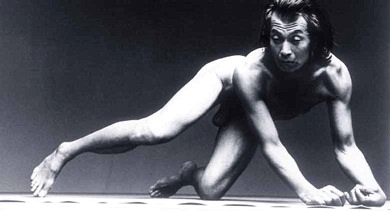
Min Tanaka at PS1. I'd never seen him live, but loved his performance in the film Tasogare Seibei (The Twilight Samurai) so I thought I'd head out to Queens. Was not crazy about this performance alone (which essentially consisted of sitting in the whipping cold attic of PS 1 while Tanaka rocked, writhed and convulsed like an Alzheimer's patient for 45 minutes); however the meal afterwards was definitely worth it.

Lulu at BAM. The Wedekind play about the life and descent of a woman who employs herself and body as a commodity. Hmm. Best thing in it was the huge white wall that started far upstage and almost unnoticed advanced incrementally throughout the play so that by the last scene, it pressed the actors practically up against the audience.


---

2007, what a wild year. All-in-all, the general level of activity was very intense. I'm feeling a bit jaded about theater. My top 3 will be pretty quick:

3. Bobby's Yudkowski Returns! (at the Brick) was a real surprise and a real joy to watch.

2. Young Jean's Church (at PS 122) -- I haven't laughed that hard in the theater in a really long time.

1. TR Warszawa's KRUM (at BAM) sincerity in the theater still exists, thank you very much. What I felt as a truthful portrayal of all the anticlimaxes of life and the fantasies needed to sustain them.

---

I did enjoy many more movies this year, and by far my favorite was the Coen Bro's No Country For Old Men. The story is framed by Tommy Lee Jones' narrator character who is an (old) man who expects the world to function according to societal consensus and order, and the antagonist murderer played by Javier Bardem who is a man who imposes his own order upon the world which he knows to be without. Thrilling to the end.

Monday, October 15, 2007

the grotesque


The two Dairakudakan Kochuten shows at work got great notices in the press, but frankly I wasn't thrilled. Maybe because I remembered their previous visits to New York so vividly. Back in 2002, they dropped into a sweltering New York summer for a series of shows that were totally fascinating, fun and exciting. There was a parade of men with sausages sticking out of their thongs -- and a hag-demon who cut off their "phalli" and weighed them on a scale, cackling; there was an underground society of creatures who sawed off their the crown of their victim's skull and ate his still-living brain; a strange slo-mo wedding procession complete with accompanying horses and stolen kisses to Andrea Bocelli's Time to Say Goodbye. Deliciously kitschy stuff.

Their latest pieces, Tiger's Cave and Yupiters did not captivate the way the other pieces did. The all-male Tiger's Cave, created by Kumotaro Mukai, was a comic imagining of a training camp for butoh dancer. An air of austerity, discipline, and asceticism is disrupted when one of their fellow trainees (or is it a teacher?) returns from a journey abroad sipping a cup of espresso and bearing gifts: a flag of France, a baguette, a pair of salt and pepper shakers, and a whip. His sauntering in to the theme song from The Triplets of Belleville infects the group and soon they've all given up the rigid butoh life for the Parisian one. At the height of this joyous revelry, the phone rings. With trepidation one of them answers. Whatever he hears on the receiver is enough to render him paralyzed and speechless. He hands the phone off to another trainee and the same thing happens to him. The third guy is finally able to spit out the words in terror: "CLEAN UP!" The pupils scamper around to destroy any evidence of their moment of fun to greet the return of their next teacher: a man/horse whose limbs are balanced precariously on the traditional Japanese laquerware. He clomps about noisily and wears a bizarre bit-like brace in his mouth that keeps his teeth perpetually bared. And so it goes on for a while. The concept is not uninteresting, but it was the indulgence and pacing that killed it for me. A reminder that what makes for a stunning picture cannot hold its own without a smart sense of time and timing.


Yupiters, the all-female companion piece by Yuko Kobayashi, proved to be much more esoteric. An ethereal trance-like landscape of ever-shifting images. The ensemble of women transformed themselves time and again, with elaborate costume changes and with extraordinary contortions. Gigantic fishbowls (with live fish) dangled from the sky. Mirrored panels surrounded the gathering, undulating wildly, creating an overload of visual information. The climax of the piece in which Kobayashi, painted entirely in silver, is surrounded by a throng of village women who prod and provoke her (without ever really touching her) and she is left to spasmodically churn and convulse, much like a fish out of water. For all its intensity and spectacle, this piece, too, left me feeling rather unmoved. Like eating at a super-fancy restaurant -- each dish looks so gorgeous, but does little to actually satisfy your hunger.

In the middle of the run I went to see the Red Bastard at the Brick Theater's NY Clown Festival. It was the 3rd time I'd seen him. While he certainly hit the mark I couldn't help but feel like he was under the weather, because he didn't wrangle his audience with the nonchalant ease with which I've seen him do so in the past. Nonetheless, he remains one of my favorite performers of that ilk -- if you've never seen him, you must, you must, you must.

Friday, September 14, 2007

Theater of the Imperfect and Impossible


The thing that drives me crazy about theater/live performance, is that it is inherently NEVER PERFECT, or rather, it highlights and revels in everything that is imperfect about being human. Of course this is where the beauty of performance lies as well -- spaces between the elements/layers that allow room for spontaneous, magical experiences. Performers hit the stage every night with a different body, a different energy, and a different audience; even within a set structure the event that coalesces can blossom into a different creature every time.

But then there is the grappling with the impossible, that can cause someone like me to develop an ulcer or burst a blood vessel in my head.

Basil Twist's Dogugaeshi is one of those shows that valiantly and beautifully wrestles with the imperfect that verges on the impossible. Commissioned by Japan Society, it premiered there in 2004, and it's back for a remount before it tours to Japan next month. It is, hands down, a unique show and beautiful -- comprised of probably about 100 gorgeously painted sliding screens set in complex systems of frames, Twist as his 3 puppeteers unravel a journey of images from old and new Japan. Once in a while a white fox puppet appears and interacts with the sliding and dividing pictures adding a lot of charm to the piece (interesting to note the audiences need/desire for a recognizable "character"). It is not only constantly changes images, though, that inspire awe. The multi-layered soundscape full of fun, surprising montages and live shamisen/koto improvisation by Yumiko Tanaka (amazing woman) and the elegant projection design (Peter Flaherty, who seems to have a monopoly on this kind of work) work in confluence with the screens for this potentially mind-blowing experience.I say potentially because, well, it is clear, without a doubt, that this is a very special, unique work of art, but having seen probably a dozen performances of it, I don't think I've seen it executed perfectly. And ok, so what is "perfection" in this kind of work? For one thing, the physical execution of a very complex sequence of moving objects. It is a fact that physical objects are clumsy. But, unlike the volatile energy and emotional states of a living breathing actor, the objects' characteristics are more predictable and reliable and consistent. So on one hand it seems perfectly possible to expect inanimate objects to achieve perfection in a way that living breathing humans cannot.

Actually in the week it's taken me to write this darned post, the show has really blossomed -- as if these painted panels are now breathing. Pretty darned amazing. Showing for two more nights. Sold out, but you should try to get waitlisted.

Friday, June 01, 2007

Technology Kills Art?


Koosil-ja's latest version of mech[a]OUTPUT sounds great on paper. A multimedia work from the dynamic Korean-Japanese-American choreographer/singer re-de-constructing the classic noh play Dojo-ji from a feminist p.o.v. and live performer-technology interaction with video (a la Wooster Group), live 3-D game space, live music and a swinging digital bell.

Dojoji itself is based on an old Japanese legend in which a love-lorn woman spurned by a monk chases him into a temple where he hides inside a bell, at which point her jealous rage turns her into a gigantic serpent and she coils herself around the bell breathing fire and roasts him alive. Alternate versions have the temple monks' fervent prayers releasing the woman from her earthly attachments and ascending to heaven, or sometimes she is the one who hides herself away from the world in the bell where she transforms into her reptilian-monster self, and ultimately just slithers away into the river. yowzers. The noh play, of course, with a super-refined and rigid performance form passed down through centuries from performer to performer, is a slow, intense display of subtle emotion. As is the "Japanese" aesthetic of wabisabi focus is on restraint, and that which is NOT apparent, as much as it is about what is. To the western layman, noh would probably be intolerable to watch and boring as hell.

With such fecund material and willing and skilled collaborators at hand, it is difficult for me to admit that mech[a]OUTPUT was a exciting as someone's master's thesis. There was no seamless marriage between concept and art -- there was high concept, flapping dryly in the wind, and there was great skill, embodied in Koosil-ja's heartrending voice and fierce physicality. But the two seemed never to meld or complement each other, leaving both heart and brain to drift off. It also didn't help that the transitions were handled with utter clumsiness and artlessness. Perhaps with the aid of an editor or director, these elements could have been shaped into a theatrically satisfying event. But as is, it was output to be forsaken.

Thursday, April 12, 2007

the river that separates the living from the dead

The River of Styx (no, not the band) is, in Western mythology, the river one must cross to reach the netherworld, after death. Also known as the river of hate, Styx winds around Hades (hell) nine times. You need a coin to pay the boatman Charon (usually portrayed as a reticent, creaky skeleton in a black hooded robe). Styx is the river Orpheus crossed in order to retrieve his wife Euridice from the land of the dead.

A similar river exists in Japanese Buddhist mythology; the dead must cross the Sanzu no Kawa (Sanzu River) to reach the underworld -- and one's karma determines where in the river he crosses: the jeweled bridge for the exceedingly good, a ford for the regular folk, or the serpent and demon-infested waters for the particularly sinful; and similarly, the dead are buried with six coins to pay the boatman. I don't know why water myths appeal to me so much, but they do -- love the boy-dragon in Spirited Away who turns out to be the river in which Chihiro played as a child -- and the Buddhist myths about the Naga dragon who lives in the Mekong River near the border of Laos and Thailand where purportedly, the creature is responsible for catapulting fireballs from the water into the air every October.

The 15th century noh play Sumidagawa (Sumida River) refers to the river that winds through Tokyo to the bay -- which you can still take a touristy water taxi on today -- it's smaller and slightly more exciting (and probably a lot dirtier) than the Hudson. In the noh play this local river becomes, like the River Styx, a metaphor for the body of water that separates the living and the dead: a crazed mother in search of her kidnapped son takes a boat across the river. On the opposite bank of the river, she finds a crowd of people gathered around a tomb to hold a chanting rite for a stray child who died there exactly a year ago. The mother realizes that the child was undoubtedly her lost son. She hears her son's voice among the chanting crowd and even sees his image behind the tomb, but when she reaches out to touch him, he disappears.

British composer Benjamin Britten was so moved by the original noh Sumidagawa when he saw the performance in Japan in 1956, he returned to his home country of England where, 8 years later, the first performance of his version, Curlew River took place. His was an opera, a parable for church performance, and Buddhist references are replaced by Christian ones, but the storyline follows the noh quite faithfully. The current production at my job, originally produced by Opera Rouen, feels surprisingly evocative of its original noh inspiration. Let me say right now that I am NOT an opera fan, in fact I would outright say that I rather dislike opera -- the singing style, though virtuosic, has never sunk in for me. But director Yoshi Oida, and conductor David Stern, made this work as palatable as it could have been, for me. The musicians and performers entered from the back of the house, deliberately, very much like the (excruciatingly slow) entrances of noh performers. Costume changes take place on stage, both acknowledging the presentational nature of the performance as well as respecting the theater as a place of transformation (of time, of space). There are no elaborate set changes, but in the simplicity of choices (lighting water effects - though artificial; a real pool of water downstage, and the monks floating candle offerings in it), Oida time and again evokes the austerity of the noh tradition. Except for the Spirit of the Boy who does not appear on stage, the cast was all-male; and Michael Bennett as The Madwoman gives a heartrending performance, especially pitted against the cocky Ferryman (Reuben Willcox). Britten's music is not easy to listen to -- it is not immediately catchy nor comfortably melodic -- but it is powerful. Like a noh play, the plot unfolds in a heavy (at times soporific) trundle; but the peaks and jagged edges of the musical composition (played by the Opera Rouen ensemble which filled the theater beautifully) kept me emotionally engaged.

Friday, March 23, 2007

Crazy Women and the Men They Ensnare

The first play I saw by Takeshi Kawamura was back in 2000. Hamlet Clone played in the Asahi Square A in Tokyo. I found this piece disorienting and incomprehensible -- like Hamlet Machine on acid. High school girls writhing around, a guy on a bicycle spouting off an unending monologue, and the director himself, perched on a high throne (I kid you not) in the middle of the audience, speaking text into a mic, like the voice of God. I had never seen such an explicit (blatant and shameless) display of artist ego weaved into the structure of a play. So when I watched his most recent offering AOI/KOMACHI on DVD I was surprised to find how accessible it was - and yet it retained the fascination, eroticism and grotesqueness of his aesthetic.

He had taken two classic noh plays and adapted them for contemporary theater. The original Aoi no Ue is a revenge story; Hikaru's lover Lady Aoi has fallen ill with a mysterious sickness. Turns out, the spirit of Hikaru's former (spurned) lover Rokujo has made Aoi sick. Kawamura sets his AOI in the salon of a karisuma biyoshi [charisma beautician] - apparently a real trend in Japan where coiffures themselves are elevated to the status of celebrity. Hikaru, the hairstylist (who has made hair not only his profession but his sexual obsession), has a young long-haired lover, Aoi, who, of late, has been prone to "seizures" and the like, and consequently has been in and out of a hospital. He suspects that the hair of his ex-lover Rokujo (who happens to be the wife of his primary patron, who also used him as a boy-toy) is at the root of this curse. Rokujo shows up and tries to implicate inextricable linked through sordid past - he helped her murder her husband and destroy the evidence (with sulfuric acid). Somehow, through re-living this event, Hikaru is able to release Aoi from the vengeful curse of Rokujo, though not without a price -- Aoi's jet-black hair (Hikaru's treasure) is completely shorn off. [Tamaki Kemmotsu, who played Aoi, told me she shaved her head just for this tour, FYI, you know who I'm talking to]. Each character seems to have his own version of reality which don't quite intersect with each other, leaving the audience in a strange space between fantasies, past and present. The story and acting style are extremely heightened and melodramatic, bordering on camp, but never quite taking the plunge.

KOMACHI is essentially a monologue; a down-and-out film director's mysterious journey through a strange dilapidated town where he discovers an abandoned movie house that screens forgotten films from the WWII era (many of them war propaganda, pro-Nazi), all starring the legendary actress Komachi, who has since disappeared from the film industry, some 40 years ago. The movie theater turns out to be inhabited (or haunted) by an aged couple, the woman (played by the butoh legend Akira Kasai) claiming to be Komachi. The film director, despite his fervent efforts to extricate himself, is sucked into the cycle of destructive love: any man who falls in love with the ageless beauty of Komachi is destined to die. In this case, the film maker seems doomed to wander endlessly in search of that "sweet primeval darkness," a precious essence of Japan that was lost in the war and through the process of forced democratization.

I feel weird writing about these plays when I am completely unbiased, having translated both of them into English and obsessively refining the subtitles for its tour here. But having had the privilege of seeing the show four times, I just wanted to express (mainly for myself to remember later) how thrilling and satisfying it is when theater works. There is nothing else like it, truly. Not that the production was totally mind-blowing or life-changing -- but they were both surprising and exciting, and the cumulative experience of watching them back to back, was a meditation on the ineffable nature of reality and the course of history. This is where Kawamura pulled strongly on noh theater: themes pertaining to the collapse of linear time, the co-existence of the flesh and spirit (and in many cases the spirit, brimming with earthly desire/attachment, living beyond the life of the body), and transformation of space all evoked the kind of excruciating mystique of noh, but presented in a much more palatable way (for a pop-audience). The film-maker's journey in KOMACHI held a magnetic fascination for me, all the way through to the last few scenes in which the aging Komachi exploded in a fiery dance that ended in her strangling the film-maker to death with unraveled film reels. I do wonder if the plays worked on the American audience on more than just a novelty entertainment level -- particularly AOI, which didn't quite land for me, either. But Kawamura insisted that these two pieces have to be performed back-to-back, with AOI first.
** On a side note: I feel like prominent modes and contemporary traditions of story-telling are making me more and more misogynist. I am much more compelled by male writers, and male protagonists. The female characters in AOI/KOMACHI are extreme antagonists with (self-)destructive traits/flaws. Which are fine and fun and all, but these days I feel more and more disturbed that there are no adult female characters that resonate with me -- if there is a play/film with an adult female protagonist, they always inevitably seem to revolve around romance (lack of, search for, loss of). Or they're totally crazy. I can't think of a story with an adult female protagonist that has really compelled me. I mean I loved Spirited Away and Pan's Labyrinth, but both of those were prepubescent girls --- It's like some kind of universally agreement that the only adventure a woman can have must take place prior to sexual awakening. I think about my favorite films and novels: all male protagonists. Is this my problem with my choices in books/films? Why do I feel this is such a void -- or rather, is this feeling justified, or have I become so misogynistic that I cannot relate to adult female protagonists? And do not cite Bridget Jones' Diary or I will smack you.

Thursday, February 08, 2007

Where is The Other Here, if there is no there there?

What is a human's life worth, in the end? What do we work for? Who do we work for? Do our achievements, our wealth, our accomplishments accumulate in any truly quantifiable, or rather, truly meaningful way? Or is there really only silence, nothing within nothing, nothing to hold in our cupped hands, nothing to show for after we pass? Is there something in the negative space? Are our sentiments communicated to another -- or do they outgrow their tiny containers and become unwieldy, or reticent? What if our gifts to each other only reveal themselves to be burdens? What do we owe each other in life, in death?


These are the questions that strike me thinking about the show I saw last night (and will see another 4 times) The Other Here is an intriguing piece from Big Dance Theater, and surprisingly (almost to a fault) linear and easy to follow in terms of a narrative, I found myself craving more of a sense of mystery and the painful hollowness that Ibuse's writings suggest. The company wove together (rather too comfortably for my taste) two Ibuse short stories (The Carp and Life at Mr. Tange's) and found texts from a life insurance convention. The resulting tale about an aging insurance salesman, his servant, and a carp given to him by a now-deceased friend really begins nowhere and ends nowhere -- and i don't mean that in a bad way at all. Scenes from an insurance conference (complete with sporadic questions from the convention audience) and terse, often-incomplete dialogue between characters are interspersed with heartfelt Okinawan pop songs in quotes and dances that emerge and dissipate like the wind.


The ensemble of actor-dancers held the audience with sure, playful and trustworthy hands. Though there were many people in the audience who were perplexed by the piece's seeming to never land here or there, or anywhere at all -- I thought that that was where I could find magic and resonance the most: in the liminal spaces between between form and content, story and dance.

Friday, September 15, 2006

YUBIWA Hotel: CANDIES girlish hardcore

I'll start with a kind of self-serving one... I work at Japan Society in the Performing Arts program. I do a shitload of stuff there, from contracting artists, booking/selling tours, organizing publicity, writing the playbill and brochures, writing grants, translating scripts, translating events, organizing programs/events, etc. and on and on.

This week we kicked off the season with YUBIWA Hotel's CANDIES: girlish hardcore.

Shirotama is a friend of mine. I helped her with a lot of stuff when she was in NY for 6 months on the ACC grant. She put on this crazy show that happened simultaneously in NYC and Tokyo, and the actresses connected with their scene partners via the internet. Some kind of video-conferencing program that had a deadly 8 second delay. She worked with 4 NY-based actors here and directed her 4 Japanese actors via internet too. insanity.

I feel like she is trying to express/explore the same subject matter in all of her work. Essentially - the experience of growing up as a girl. Or how a woman (a Japanese woman) is taught how to interface with the world. Though her work always has images and ideas that are engaging and striking, I always felt on some level that she fed into the objectification and fetishism of cute japanese girls, rather than opposed such phenomena or offered an alternative to them.

But CANDIES was somehow different for me. There was something very bare about this one, very vulnerable. It wouldn't make much sense for me to describe what happens here; it was essentially a series of vignettes and montages that were not really linear or narrative, many scenes accompanied by a voiceover of an older woman reciting a pensive poetic text about all the things she's lost in her life. We follow 5 girls from childhood into old age, at times wearing animal masks, moving through what should be prominent events in one's life: marriage, going to school, playing basketball, death, and making pancakes out of another woman's secretions and eating them with your best friend. always a highlight for me.

But something happened in this piece, the cumulative affect of these quizzical interactions, and the lovely finale where the 5 women discard their animal masks, frilly skirts, and dance a kind of repetitive, frenetic strip tease that ended with them putting out their cigarettes on the soles of their high-heeled shoes -- it was extremely moving. This is why I think Shirotama is pretty great, despite her idiosyncracies. She can capture these moments, and create a visceral, emotional experience out of scraps and pieces. I was left really wondering what a human being's life, a woman's life, ultimately consists of. "So, walk alone, like a rhonoceros' horn." The strength and the loneliness of abandoning one's family, friends, lovers, community. What are you without your community? What are you without your culture? Can you really shed your cultural identity? Your gender identity?

Oh Shirotama. Once she came from Japan to stay at my house, and she brought 2 other people with her -- without telling me she was bringing more people. But she's a sweetheart. She's got this big fat old orange cat she's in love with. http://www.yubiwahotel.com/